Showing posts with label Children's Books. Show all posts

Friday, December 13, 2013

Christmas Books That Make Me Cry {Repost}

{A repost from 2009 that still holds true today.}
 

The mark of a good Christmas book, for me, is that it makes me cry. We have a good number of children's books for Christmas, and I try to add a new book each year. We have some of the essential ones like How the Grinch Stole Christmas, popular ones like The Polar Express and some silly but sentimental ones like Mercer Mayer's Merry Christmas, Mom and Dad, starring Little Critter. Some of the books we give the obligatory seasonal read and then put back on the rack.

But I have my favorites. These are the books that, without fail, make me cry at some point. My voice catches, a child's head pops up and looks at me and says, "Mama! Are you crying again?" I can't help it.


1. The Tale of the Three Trees (retold by Angela Elwell Hunt): This book ties it all together—Jesus' birth, life, and death—in a simple but eloquent story. I get choked up on almost every page.


2. The Story of Holly and Ivy (by Rumer Godden): This one takes us a couple of reading periods to get through, but it is so well worth it. This is the story of an orphan who wants a grandmother, a doll who wants a home, and a woman who wants a family. I get goosebumps just thinking about it.


3. The House Without a Christmas Tree (by Gail Rock): I loved this TV special when I was a kid, but I'm not sure I'd ever read the book until a few years ago when I picked it up at a yard sale. Now my daughter and I read this story annually of a girl who begs her father for a Christmas tree, and I always cry at the end.

4. A Wish for Wings That Work (by Berkeley Breathed): Is it weird to get weepy over a book about a penguin named Opus? I can't help it; there's something about Santa saying, "Ho, ho, ho, go!" to a penguin whose wings don't work that brings tears every time. Also, this was one of the books we bought for our oldest for his first Christmas, so it's extra sentimental.

5. The First Night (by B.G. Hennessy): This short book starts off with one of my favorite Bible verses: "And the World became flesh, and dwelt among us, and we beheld His glory, glory as of the only begotten from the Father, full of grace and truth" (John 1:14) and proceeds to tell the birth of Christ in simple but poetic text. I especially love the rustic look of the paintings, done on butternut wood and shaped with a jigsaw. It's the simplicity of a birth—of a new life—that gets me every time.

And so those are my Top 5 favorite Christmas books. I have to add another one that takes awhile to read but is so well worth it: The Christmas Doll by Elvira Woodruff. This one isn't for the youngest readers, but 9 and up will love it.

Do you have one that makes you cry? If so, leave a comment and I'll check it out! Here are a few collected from comments:

The Silver Packages by Cynthia Rylant
The Crippled Lamb by Max Lucado
The Year of the Perfect Christmas Tree by Gloria Houston (I can't wait to check this one out!!)
Jotham's Journey (This one's been on my to-read list for years!)
Bagels from Benny by Aubrey Davis

Saturday, October 9, 2010

Celebrating Autumn: Books and Other Resources (repost)


(I wrote this post a couple of years ago, but as the leaves are just starting to turn a tiny bit today, I thought I'd repost. Enjoy!)

Autumn is definitely here in East Tennessee, in spite of temperatures in the 80s. The driveway is covered with leaves and the first hints of fall color are showing up in the trees. Because the Smokies get tons of visitors in autumn, the question is always: what kind of fall color will we have this year? The happy fact is that even in years, like last year, when the prediction is that we'll have a "low color" year, autumn is gorgeous around here.

In celebration of this perfect season, I thought I'd share some of my favorite resources for fall. Autumn Leaves by Ken Robbins is by far our favorite leaf book. After a brief discussion about leaf characteristics and why leaves change color, Robbins shows the reader leaf colors from trees across the country, with close-up photographs of leaves as well as photos of whole trees for easy identification. This book spans several ages. The text is simple enough for preschoolers but not too simplistic for middle readers. I think it's just a great guide book.

For preschoolers and early elementary children, Lois Elhert's Red Leaf, Yellow Leaf is an explosion of beautiful, rich color. The book traces the life of a sugar maple from seed to sapling. Kids will want to get out craft supplies and make leaf collages after reading this one.

The Let's Read and Find Out Science series has a good resource book, Why Do Leaves Change Colors? for young readers (preschool/early elementary). It's simple, with good detailed illustrations of leaves and a couple of easy craft ideas.

I've always loved authors Gail Gibbons and Anne Rockwell for probably ages 3-6. Both authors have a voice I appreciate; they don't talk down to children or dumb down their explanations. Gibbons The Seasons of Arnold's Apple Tree, which takes the reader through the changes in an apple tree though the seasons, was one of our favorite autumn books. We also enjoyed Rockwell's colorful Apples and Pumpkins. Perhaps my favorite preschool pumpkin book, however, is Jeanne Titherington's Pumpkin Pumpkin. I bought this books at a lovely toy store called The Pumpkin Patch in Ames, Iowa, where we lived when Jesse was a preschooler. I love the gentle colored pencil drawings and the little boy who looked so much like my own child.

Here are a few more books that look wonderful. I'll be looking for at least a couple of these at our library:
Autumn: An Alphabet Acrostic
It's Fall
Fall Is Here!
I Know It's Autumn
When Autumn Comes

You can do a search for "fall crafts" or "autumn crafts" and get tons of ideas for various age levels. My younger children are 7 and 11, so we have moved away from coloring pages and handprint crafts for the most part. This year we'll be doing:
Nature Luminary Candle Holders
Melted Crayon Stained Glass Windows
Leaf Rubbings

The sites below have lots of great activities and ideas for enjoying autumn. I especially love the ideas at Easy Fun School.• Easy Fun School:
• Autumn Science
• Autumn unit study at Seven Pillars Book Nook
• Lots of great fall activities at Enchanted Learning
• Fall Leaf Guide is an easy guide to identifying trees by the color and shape of foliage; the chemistry, physics and geometry of fall color; and more. Sounds complicated, but the explanations are very short and sweet. This guide highlights Tennessee trees but can be used wherever seasons change.
Of course, most importantly, get out and play in the leaves!

Friday, January 1, 2010

2009 Books Read and Reviewed

For those of you who are faithful readers of both my blogs, I apologize for this duplicate post. But some of you may not know that I carry on another life on my reading blog, SmallWorld Reads. And today I finished a most satisfying task: compiling my list of my Top 10 Favorite Books of the year. Click that link to go to my reading blog, or read on below. I hope you add some of my favorites to your own TBR lists, if you haven't read them already!

I read 65 books in 2009, including 20 children's or young adult chapter books (I didn't include history books, picture books, etc.) that I either read to my kids or taught in various co-op classes.

It was a good year for reading, although I was often frustrated with myself for failing to read faster. I fell asleep too frequently during my allotted before-bed reading time. Someday I will again be a person who reads during the day, but for this season of my life, I must be content with my bedtime reading.

And so, out of those 45 "adult" books read, here are my favorites:

The Top 10

Count of Monte Cristo (Alexandre Dumas)
Cutting for Stone (Abraham Verghese)
Day After Night (Anita Diamant)
Guernsey Literary and Potato Peel Pie Society (Shaffer and Barrows)
Other Side of the Bridge, The (Mary Lawson)
People of the Book (Geraldine Brooks)
Road, The (Cormac McCarthy)
Sarah's Key (Tatiana de Rosnay)
Skeletons at the Feast (Chris Bohjalian)
Prayers for Sale (Sandra Dallas)

It was hard for me to narrow this down. I had about eight other contenders for the Top 10 list, but I'm sticking with the list above. These are books that are especially memorable to me. They were well-written, poignant, and captured my attention and imagination more than the others.

And for my number one favorite novel of the year: Cutting for Stone by Abraham Verghese. Part of the draw for me is the "sweeping epic" aspect of this novel. I love "sweeping epics" that span generations. A book like this gives me that sense of closure. Nearly all my questions as a reader were answered; the prose was perfect; and I felt truly satisfied upon finishing the novel.

Below are my two lists. Click on the titles for my reviews of nearly all these books. (A few of the children's books didn't get reviewed.) If the book as one or two asterisks** by the title, I can't really recommend it with any sort of enthusiasm.

The Whole List of Books Read in 2009


Children's Chapter & YA Books Read/Taught
Abe Lincoln Grows Up by Carl Sandburg
Across Five Aprils by Irene Hunt
Bound for Oregon: by Jean van Leeuwen
Boy in the Striped Pajamas (John Boyne)
Caddie Woodlawn by Carol Ryrie Brink
Children of the River (Linda Crew)
The Christmas Doll by Elvira Woodruff
Dear Mr. President: Abraham Lincoln--Letters from a Slave Girl (Andrea D. Pinkey)
Dragon of Trelian by Michelle Knudson
George Washington Carver: From Slave to Scientist by Geoff and Janet Benge
Little Britches by Ralph Moody
Number the Stars by Lois Lowry
Sadako and the Thousand Paper Cranes by Eleanor Coerr
Snow Treasure by Marie McSwigan
Sounder by William Armstrong
Road to Paris (Nikki Grimes) YA
Sonshine Girls: Summer Secret (Rene Morris)
Stargirl (Jerry Spinelli)
Ties That Bind, Ties That Break (Lensey Namioka)
Wright Brothers by Quentin Reynolds

And there we have a year of reading in my own Small World. I've started 2010 out with a bang, having just finished John Iriving's Late Night in Twisted River. How will the rest of the year measure up?

For more reading lists, check out Semicolon's blog beginning on Saturday, Jan. 2.

Friday, November 27, 2009

Christmas Books That Make Me Cry


With today being the biggest Christmas shopping day of the year and the time when putting up decorations becomes acceptable in my humble opinion, I thought I'd set you all thinking about good Christmas reading with this repost from last year. Now is the perfect time to add a few books to your Christmas collection and start reading a few every evening!

The mark of a good Christmas book, for me, is that it makes me cry. We have a good number of children's books for Christmas, and I try to add a new book each year. We have some of the essential ones like How the Grinch Stole Christmas, popular ones like The Polar Express and some silly but sentimental ones like Mercer Mayer's Merry Christmas, Mom and Dad, starring Little Critter. Some of the books we give the obligatory seasonal read and then put back on the rack.

But I have my favorites. These are the books that, without fail, make me cry at some point. My voice catches, a child's head pops up and looks at me and says, "Mama! Are you crying again?" I can't help it.


1. The Tale of the Three Trees (retold by Angela Elwell Hunt): This book ties it all together—Jesus' birth, life, and death—in a simple but eloquent story. I get choked up on almost every page.


2. The Story of Holly and Ivy (by Rumer Godden): This one takes us a couple of reading periods to get through, but it is so well worth it. This is the story of an orphan who wants a grandmother, a doll who wants a home, and a woman who wants a family. I get goosebumps just thinking about it.


3. The House Without a Christmas Tree (by Gail Rock): I loved this TV special when I was a kid, but I'm not sure I'd ever read the book until a few years ago when I picked it up at a yard sale. Now my daughter and I read this story annually of a girl who begs her father for a Christmas tree, and I always cry at the end.

4. A Wish for Wings That Work (by Berkeley Breathed): Is it weird to get weepy over a book about a penguin named Opus? I can't help it; there's something about Santa saying, "Ho, ho, ho, go!" to a penguin whose wings don't work that brings tears every time. Also, this was one of the books we bought for our oldest for his first Christmas, so it's extra sentimental.

5. The First Night (by B.G. Hennessy): This short book starts off with one of my favorite Bible verses: "And the World became flesh, and dwelt among us, and we beheld His glory, glory as of the only begotten from the Father, full of grace and truth" (John 1:14) and proceeds to tell the birth of Christ in simple but poetic text. I especially love the rustic look of the paintings, done on butternut wood and shaped with a jigsaw. It's the simplicity of a birth—of a new life—that gets me every time.

And so those are my Top 5 favorite Christmas books. I have to add another one that takes awhile to read but is so well worth it: The Christmas Doll by Elvira Woodruff. This one isn't for the youngest readers, but 9 and up will love it.

Do you have one that makes you cry? If so, leave a comment and I'll check it out! Here are a few collected from last year's comments:

The Silver Packages by Cynthia Rylant
The Crippled Lamb by Max Lucado
The Year of the Perfect Christmas Tree by Gloria Houston (I can't wait to check this one out!!)
Jotham's Journey (This one's been on my to-read list for years!)
Bagels from Benny by Aubrey Davis

Friday, April 3, 2009

National Poetry Month: Reading Poetry with Children

Whatever you do, find ways to read poetry. Eat it, drink it, enjoy it, and share it.”
~Eve Merriam


Did you know that April is National Poetry Month? I find it hard to call myself a "writer" but that is what I am at the core, and even more specifically, I am a writer of poetry. Sadly, poetry is terribly misunderstood because most of us read so much incomprehensible poetry when we were in school and learned to dislike it. During this month, I'll be tossing out poetry suggestions every now and then. For now, here is a repost from last year about poetry for children:

Before I list my favorite books written specifically for children, let me emphasize that you don't have to stick with "kids' poetry" when reading to your children. In other words, some poets write specifically for a younger audience--much of Jack Prelutsky, for example. But poetry doesn't have to rhyme and be about cute kitties or dog poop to appeal to children (although rhyming bodily functions certainly can heighten a child's appreciation of poetry).

Along those lines, I highly recommend A Treasury of Poetry for Young People. This contains poems selected with a younger audience (5th grade and up) in mind by some of the best-known poets: Carl Sandburg, Robert Frost, Emily Dickinson, Edgar Allen Poe, Walt Whitman and Henry Wadsworth Longfellow. There is a two or three page introduction of each author before his/her section of poetry. The illustrations are simple and beautiful. Notes at the bottom of each page give a very brief commentary on each poem. For example, at the end of the familiar Frost poem "The Road Not Taken," the note simply states: "We all know the feel of a cool autumn day, when we can shuffle our feet through fallen leaves and kick up the smells of the season. This is a poem about such a walk, about coming to a fork in the path, and about making choices in our lives."

For a wider variety of poets, I recommend the Poetry for Young People Series. These books are also published by Sterling Publishing, like the one above, but each books features a different poet. Scholastic often has these titles in their monthly sale fliers for home or school. Featured authors include: Robert Browning, Langston Hughes, Edna St. Vincent Millay, and all the ones mentioned above.

One more collection I really love for kids: The Oxford Illustrated Book of American Children's Poems, edited by Donald Hall. This one takes a chronological approach to American poetry, beginning with the Native American cradle song, "Chant to the Fire-Fly" and ending with the contemporary poetry of Sandra Cisneros and Janet S. Wong. I love the diversity offered in this collection: poetry isn't all written by white guys and reclusive women. And one of my personal favorites is included here: Nikki Giovanni's "Knoxville, Tennessee." Even if you don't live around these parts, you and your children can surely relate to Giovanni's ode to the pure bliss of summertime.

Of course, you can get out your old copy of The Norton Anthology of Poetry and just pick out age-appropriate poems from some of the world's best poets of all time. What? You don't have an old Norton's Anthology? Run to your nearest used bookstore or Goodwill and pick one up. Please. You never know when you might need to read T.S. Eliot's "The Love Song of J. Alfred Prufrock":
I grow old. . . . I grow old . . .
I shall wear the bottoms of my trouser rolled.
Shall I part my hair behind? Do I dare to eat a peach?
I shall wear white flannel trousers, and walk upon the beach.
I have heard the mermaids singing, each to each.
I do not think they will sing to me.

But I digress. Moving on to poetry written specifically for children, I must present my four favorites: Shel Silverstein, Jack Prelutsky, Eve Merriam, and Valerie Worth. Does anyone not know Shel Silverstein's works? Silverstein, who died in 1999, is the king of children's poetry. His website is great fun, and you can read all about his works there. You local library will have every book; better yet, buy at least a couple. No family library can possibly be complete with A Light in the Attic or Where the Sidewalk Ends. If your kids hear the word "poetry" and cover their ears, try reading "Sarah Cynthia Sylvia Stout Would Not Take the Garbage Out' to them. They will want to hear more.

Jack Prelutsky also has a gift for luring children in with the absurd. He knows how to engage children with the silly, absurd, and irresistibly disgusting:
Slime, slime,
Savory slime,
you're luscious and succulent
any old time,
there's hardly a thing
that is nearly as grand
as a dollop of slime
in the palm of my hand.

Prelutsky also has a great website, where you can read all about him and his books and get teaching ideas, too.

The poet Eve Merriam loved language--loved the sound of words alone and in combination with other words. When I read her poetry, I imagine how carefully she chose each word. From her widely anthologized "Lullaby":

Purple as a king's cape
Purple as a grape.

Purple for the evening
When daylight is leaving.

Soft and purry,

Gentle and furry,

Velvet evening-time.
 
I have a cassette tape of Merriam reading some of her poetry; when my oldest was little, this was one of his favorites. Check out your local library or amazon.com for poetry by Eve Merriam, including You Be Good and I'll Be Night and A Sky Full of Poems.

One last poet who might be less familiar but who also takes great care in crafting poetry: Valerie Worth. In the wonderful All the Small Poems and Fourteen More, Worth turns every day things--animal, vegetable and mineral--into exquisite works of art. This is a fantastic collection for teaching personification, metaphor and simile, and for emphasizing the power of observation and the craft of language.
The sun
is a leaping fire
too hot
to go near,
But it will still
lie down
in warm yellow squares
on the floor
lie a flat
quilt, where
the cat can curl
and purr.

This is just a tiny taste of the wonderful feast that is the world of poetry. Surf the internet and shuffle through the library bookshelves. If you had a bad experience with poetry in your own schooling, try again--with your child. I promise, you'll both find something you love.

(And check out my FREE creative writing workshop—SmallWorld's WordSmithery— on the sidebar!)

Monday, December 22, 2008

Christmas Books That Make Me Cry


The mark of a good Christmas book, for me, is that it makes me cry. We have a good number of children's books for Christmas, and I try to add a new book each year. We have some of the popular ones like The Polar Express and some silly but sentimental ones like Mercer Mayer's Merry Christmas, Mom and Dad, starring Little Critter. Some of the books we give the obligatory seasonal read and then put back on the rack.

But I have my favorites. These are the books that, without fail, make me cry at some point. My voice catches, a child's head pops up and looks at me and says, "Mama! Are you crying again?" I can't help it.


1. The Tale of the Three Trees (retold by Angela Elwell Hunt): This book ties it all together—Jesus' birth, life, and death—in a simple but eloquent story. I get choked up on almost every page.


2. The Story of Holly and Ivy (by Rumer Godden): This one takes us a couple of reading periods to get through, but it is so well worth it. This is the story of an orphan who wants a grandmother, a doll who wants a home, and a woman who wants a family. I get goosebumps just thinking about it.


3. The House Without a Christmas Tree (by Gail Rock): I loved this TV special when I was a kid, but I'm not sure I'd ever read the book until a few years ago when I picked it up at a yard sale. Now my daughter and I read this story annually of a girl who begs her father for a Christmas tree, and I always cry at the end.

4. A Wish for Wings That Work (by Berkeley Breathed): Is it weird to get weepy over a book about a penguin named Opus? I can't help it; there's something about Santa saying, "Ho, ho, ho, go!" to a penguin whose wings don't work that brings tears every time. Also, this was one of the books we bought for our oldest for his first Christmas, so it's extra sentimental.

5. The First Night (by B.G. Hennessy): This short book starts off with one of my favorite Bible verses: "And the World became flesh, and dwelt among us, and we beheld His glory, glory as of the only begotten from the Father, full of grace and truth" (John 1:14) and proceeds to tell the birth of Christ in simple but poetic text. I especially love the rustic look of the paintings, done on butternut wood and shaped with a jigsaw. It's the simplicity of a birth—of a new life—that gets me every time.

And so those are my Top 5 favorite Christmas books. Do you have one that makes you cry? If so, leave a comment and I'll check it out! (And my apologies to those of you who also read SmallWorld Reads for this duplicate post!)

Monday, October 13, 2008

Celebrating Autumn: Books and Other Resources

Autumn is definitely here in East Tennessee, in spite of temperatures in the 80s. The driveway is covered with leaves and the first hints of fall color are showing up in the trees. Because the Smokies get tons of visitors in autumn, the question is always: what kind of fall color will we have this year? The happy fact is that even in years, like last year, when the prediction is that we'll have a "low color" year, autumn is gorgeous around here.

In celebration of this perfect season, I thought I'd share some of my favorite resources for fall. Autumn Leaves by Ken Robbins is by far our favorite leaf book. After a brief discussion about leaf characteristics and why leaves change color, Robbins shows the reader leaf colors from trees across the country, with close-up photographs of leaves as well as photos of whole trees for easy identification. This book spans several ages. The text is simple enough for preschoolers but not too simplistic for middle readers. I think it's just a great guide book.

For preschoolers and early elementary children, Lois Elhert's Red Leaf, Yellow Leaf is an explosion of beautiful, rich color. The book traces the life of a sugar maple from seed to sapling. Kids will want to get out craft supplies and make leaf collages after reading this one.

The Let's Read and Find Out Science series has a good resource book, Why Do Leaves Change Colors? for young readers (preschool/early elementary). It's simple, with good detailed illustrations of leaves and a couple of easy craft ideas.

I've always loved authors Gail Gibbons and Anne Rockwell for probably ages 3-6. Both authors have a voice I appreciate; they don't talk down to children or dumb down their explanations. Gibbons The Seasons of Arnold's Apple Tree, which takes the reader through the changes in an apple tree though the seasons, was one of our favorite autumn books. We also enjoyed Rockwell's colorful Apples and Pumpkins. Perhaps my favorite preschool pumpkin book, however, is Jeanne Titherington's Pumpkin Pumpkin. I bought this books at a lovely toy store called The Pumpkin Patch in Ames, Iowa, where we lived when Jesse was a preschooler. I love the gentle colored pencil drawings and the little boy who looked so much like my own child.

Here are a few more books that look wonderful. I'll be looking for at least a couple of these at our library:
Autumn: An Alphabet Acrostic
It's Fall
Fall Is Here!
I Know It's Autumn
When Autumn Comes

You can do a search for "fall crafts" or "autumn crafts" and get tons of ideas for various age levels. My younger children are 7 and 11, so we have moved away from coloring pages and handprint crafts for the most part. This year we'll be doing:
Nature Luminary Candle Holders
Melted Crayon Stained Glass Windows
Leaf Rubbings

The sites below have lots of great activities and ideas for enjoying autumn. I especially love the ideas at Easy Fun School.• Easy Fun School:
• Autumn Science
• Autumn unit study at Seven Pillars Book Nook
• Lots of great fall activities at Enchanted Learning
• Fall Leaf Guide is an easy guide to identifying trees by the color and shape of foliage; the chemistry, physics and geometry of fall color; and more. Sounds complicated, but the explanations are very short and sweet. This guide highlights Tennessee trees but can be used wherever seasons change.
Of course, most importantly, get out and play in the leaves!

Related posts here on SmallWorld:
Apple Unit Study
In the Smokies: Selected Readings

Tuesday, June 17, 2008

In the Smokies: Selected Reading


We spent much of Sunday in the Smokies—the perfect Father's Day gift for Dr. H. The day was absolutely perfect in every way. Having these beautiful mountains 20-30 minutes away is amazing. I often forget that the Great Smoky Mountain National Park is the most visited national park in the U.S., with 9 million visitors each year. We used to avoid going to the Smokies on weekends from June-October because the traffic can be bumper-to-bumper, and that is not a pleasant way to spend one's day in the mountains. But we know lots of off-the-beaten path places now that are quick to get to and very quiet, and there is just nothing like being in the mountains by the river on a hot summer day.

If you haven't visited the Smokies, please don't let the 9 million tourists scare you off. Only 1 million of them actually do more than drive through; the other 8 million spend most of their time doing stuff in Gatlinburg. If you want a serene mountain experience, you may want to consider avoiding the touristy and heavily trafficked Gatlinburg and Pigeon Forge. There are many other entrances to the park that are quiet and beautiful, including Townsend, the tiny town just south of us.

I'm going to share a few of our favorite books about the Smokies. My favorite kids books are these two written by Lisa Horstman: The Troublesome Cub and The Great Smoky Mountain Salamander Ball. Another must-have if you are visiting the park is Who Pooped in the Park? (These are available for all the national parks, so be sure to get the Smokies-specific one.) I love this beautiful Appalachian ABCs, and Cynthia Rylant's When I Was Young in the Mountains --the story of a childhood in the mountains--is pure poetry. Speaking of poetry, Nikki Giovanni is from Knoxville, and I love the picture book based on her poem "Knoxville, Tennessee."

For young adults (and adult readers, too), Catherine Marshall's Christy is a classic. This is the story of a privileged young society woman who goes to teach school to the mountain kids in the Smokies. For younger readers, there is a good series of chapter books based on the novel Christy; my 10-year-old loves these books. She also loves the Mandie books by Lois Gladys Leppard, which all take place in and around the Smokies.

I've noticed that the Southern Literature challenge is a popular challenge this summer in the book blog community. I am a huge fan of Southern Lit, both classic and contemporary. A few of contemporary authors whose novels take place in and around the Smokies are Sharyn McCrumb, Adriana Trigiani, and Robert Morgan. In She Walks These Hills, McCrumb weaves a modern-day mystery in with a mountain legend. I'm not crazy about McCrumb's Elizabeth MacPherson mystery books, but I absolutely love her Southern mountain novels. Others include If I Ever Return, Pretty Peggy-O; The Ballad of Frankie Silver; The Songcatcher; The Hangman's Beautiful Daughter; and a couple others. While each novel stands on its own, many of the same characters appear in all the novels.

Adriana Trigiani has a collection of three novels--Big Stone Gap, Big Cherry Holler, and Milk Glass Moon--that take place over in Virginia. They're not exactly Smoky Mountain lit, but the characters and dialect would fit right in here. I've just noticed that there is a fourth in the series now, Home to Big Stone Gap, which I'll be adding to my TBR list.

Robert Morgan is one of my favorite Southern writers. He is much more lyrical than Trigiani and McCrumb. I haven't read all his books, including his newest one Boone, but I love what I've read: This Rock, The Truest Pleasure, Gap Creek, and The Hinterlands. His characters, dialect, setting--everything is beautiful and true to the area. You can imagine Morgan as an oral storyteller in each of these books.

One more fascinating novel that takes place in the Smoky Mountains is Francine Rivers' The Last Sin Eater. The story is about the old folk custom of a community "sin eater," who is said to absolve the residents of their sins by "eating them." I had never heard of this odd custom until reading this book, and I found the concept fascinating.

All of the above reading material provides a great introduction to this unique mountain area. I would be remiss if I didn't recommend a couple of great guides for once you are actually in the Smokies. Dr. H. has two favorites. Hiking Trails of the Great Smoky Mountains by Kenneth Wise is his favorite for family-type hikes and excursion. For tougher, more backcountry hikes, he recommends Hiking Trails of the Smokies, which is published by the GSMNP service.

Have I whet your appetite for the Great Smoky Mountains? Even if you can't come for a visit, you can get a taste of the Smokies in these books.

Thursday, May 1, 2008

Book Reviews: Poetry for Children

May 1, 2008

Whatever you do, find ways to read poetry. Eat it, drink it, enjoy it, and share it.”
~Eve Merriam


A commenter asked me a couple of weeks ago for suggestions for poetry to read to children. Before I list my favorite books written specifically for children, let me emphasize that you don't have to stick with "kids' poetry" when reading to your children. In other words, some poets write specifically for a younger audience--much of Jack Prelutsky, for example. But poetry doesn't have to rhyme and be about cute kitties or dog poop to appeal to children (although rhyming bodily functions certainly can heighten a child's appreciation of poetry).

Along those lines, I highly recommend A Treasury of Poetry for Young People. This contains poems selected with a younger audience (5th grade and up) in mind by some of the best-known poets: Carl Sandburg, Robert Frost, Emily Dickinson, Edgar Allen Poe, Walt Whitman and Henry Wadsworth Longfellow. There is a two or three page introduction of each author before his/her section of poetry. The illustrations are simple and beautiful. Notes at the bottom of each page give a very brief commentary on each poem. For example, at the end of the familiar Frost poem "The Road Not Taken," the note simply states: "We all know the feel of a cool autumn day, when we can shuffle our feet through fallen leaves and kick up the smells of the season. This is a poem about such a walk, about coming to a fork in the path, and about making choices in our lives."

For a wider variety of poets, I recommend the Poetry for Young People Series. These books are also published by Sterling Publishing, like the one above, but each books features a different poet. Scholastic often has these titles in their monthly sale fliers for home or school. Featured authors include: Robert Browning, Langston Hughes, Edna St. Vincent Millay, and all the ones mentioned above.

One more collection I really love for kids: The Oxford Illustrated Book of American Children's Poems, edited by Donald Hall. This one takes a chronological approach to American poetry, beginning with the Native American cradle song, "Chant to the Fire-Fly" and ending with the contemporary poetry of Sandra Cisneros and Janet S. Wong. I love the diversity offered in this collection: poetry isn't all written by white guys and reclusive women. And one of my personal favorites is included here: Nikki Giovanni's "Knoxville, Tennessee." Even if you don't live around these parts, you and your children can surely relate to Giovanni's ode to the pure bliss of summertime.

Of course, you can get out your old copy of The Norton Anthology of Poetry and just pick out age-appropriate poems from some of the world's best poets of all time. What? You don't have an old Norton's Anthology? Run to your nearest used bookstore or Goodwill and pick one up. Please. You never know when you might need to read T.S. Eliot's "The Love Song of J. Alfred Prufrock":
I grow old. . . . I grow old . . .
I shall wear the bottoms of my trouser rolled.
Shall I part my hair behind? Do I dare to eat a peach?
I shall wear white flannel trousers, and walk upon the beach.
I have heard the mermaids singing, each to each.
I do not think they will sing to me.

But I digress. Moving on to poetry written specifically for children, I must present my four favorites: Shel Silverstein, Jack Prelutsky, Eve Merriam, and Valerie Worth. Does anyone not know Shel Silverstein's works? Silverstein, who died in 1999, is the king of children's poetry. His website is great fun, and you can read all about his works there. You local library will have every book; better yet, buy at least a couple. No family library can possibly be complete with A Light in the Attic or Where the Sidewalk Ends. If your kids hear the word "poetry" and cover their ears, try reading "Sarah Cynthia Sylvia Stout Would Not Take the Garbage Out' to them. They will want to hear more.

Jack Prelutsky also has a gift for luring children in with the absurd. He knows how to engage children with the silly, absurd, and irresistibly disgusting:
Slime, slime,
Savory slime,
you're luscious and succulent
any old time,
there's hardly a thing
that is nearly as grand
as a dollop of slime
in the palm of my hand.

Prelutsky also has a great website, where you can read all about him and his books and get teaching ideas, too.

The poet Eve Merriam loved language--loved the sound of words alone and in combination with other words. When I read her poetry, I imagine how carefully she chose each word. From her widely anthologized "Lullaby":

Purple as a king's cape
Purple as a grape.

Purple for the evening
When daylight is leaving.

Soft and purry,

Gentle and furry,

Velvet evening-time.
 
I have a cassette tape of Merriam reading some of her poetry; when my oldest was little, this was one of his favorites. Check out your local library or amazon.com for poetry by Eve Merriam, including You Be Good and I'll Be Night and A Sky Full of Poems.

One last poet who might be less familiar but who also takes great care in crafting poetry: Valerie Worth. In the wonderful All the Small Poems and Fourteen More, Worth turns every day things--animal, vegetable and mineral--into exquisite works of art. This is a fantastic collection for teaching personification, metaphor and simile, and for emphasizing the power of observation and the craft of language.
The sun
is a leaping fire
too hot
to go near,
But it will still
lie down
in warm yellow squares
on the floor
lie a flat
quilt, where
the cat can curl
and purr.

This is just a tiny taste of the wonderful feast that is the world of poetry. Surf the internet and shuffle through the library bookshelves. If you had a bad experience with poetry in your own schooling, try again--with your child. I promise, you'll both find something you love.

Saturday, April 26, 2008

Book Review: Three by Barefoot Books

April 26, 2008


Barefoot Books is a relatively new publisher, started in 1993 by moms Nancy Traversy and Tessa Strickland. They describe their story and vision:
When you start out, no one has heard of you, and you wonder if anyone is going to listen to what you have to say. No one was publishing books quite like ours—would anyone buy them? We believed they would; we just had to find our way to parents and educators who shared our values. This is what we care about: first, we're convinced that it's never too early to introduce children to other cultures. We believe too that children can appreciate high-quality art, and enjoy the music as well as the meaning of language from a very early age.

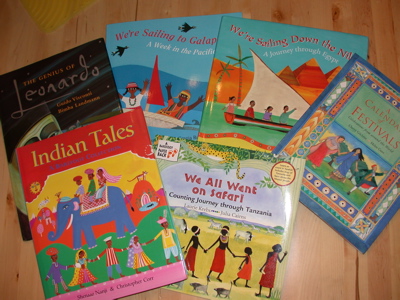
I love books that feature different cultures, and Barefoot Books does this well. My first-grader loves three "travel" books: We're Sailing to Galapagos, We All Went on Safari, and We're Sailing Down the Nile. First of all, the books are gorgeous. The illustrations are bright and colorful without being too chaotic and cluttered. Each book gives geographical and cultural details in fun, sing-song verses.

We're Sailing to Galapagos: A Week in the Pacific, is our favorite. The rhyming text introduced the wildlife of the Galapagos Islands, from albatrosses to lava crabs. Duncan loves the repeated chorus:
"We're sailing to Galapagos, Galapagos, Galapagos,
We're sailing to Galapagos. I wonder who we'll see."

This book made me want to do a unit study on the Galapagos! The last several pages of the book give more detail about the Islands and its animal inhabitants.

We All Went on Safari: A Counting Journey Through Tanzania, is beautiful counting/language/ culture/wildlife book. A group of Maasai people journey over Tanzanian grasslands and past acacia trees, counting various African animals--in both English and Swahili. Like the Galapagos book, this one devotes several pages at the end to information about the Maasai people, the Swahili language, and facts about Tanzania. This would be a great supplement to any study of African countries.

We're Sailing Down the Nile: A Journey Through Egypt is the least engaging of the three for us. Somehow the rhythm doesn't flow as well as the other two, and the illustrations weren't as engaging. I guess also, there is so much great material out there already about Egypt but not much about Tanzania and the Galapagos, so the first two books really stood out for me.

I think Barefoot Books will be a solid contender in the children's book market. The books are reminiscent of Usborne Books but with more of a cultural rather than historical focus--and the illustrations are more vibrant. I see on their site that, like Usborne, one can run a home-based business by selling Barefoot Books. I used to sell Usborne in this way and accumulated a wonderful library; if my children were younger, I'd consider selling Barefoot! They also have an affiliate program like Amazon. Don't be surprised if you see an affiliate button on my blog in a few days!

Friday, April 25, 2008

Book Review: Boston Tea Party

April 25, 2008


Here in our own small world, we have been immersed in the Revolutionary War era for several weeks now. This fabulous picture book written by Pamela Duncan Edwards and illustrated by Henry Cole really ties it all together in a way that was perfect for both my 1st and 5th graders. The story is actually told in imitation of the nursery rhyme "This is the house that Jack built," which sounds really silly, but it was incredibly effective. The narrative opens with "These are the leaves that grew on a bush in a far off land and became part of the Boston Tea Party" and builds from there, to ultimately lead to "These are Americans, independent and free..." In between the story of the prelude to the Revolutionary War is told. At the bottom of each page, a chorus of mice spout off more details about this time period. Sounds weird, I know, but those are smart little mice. And the illustrations are absolutely gorgeous. This is a book that needs to start being on all of the lists of "recommended reading for the Revolutionary War."

Friday, October 5, 2007

Curriculum Review: Usborne's I Can Draw Series

October 5, 2007


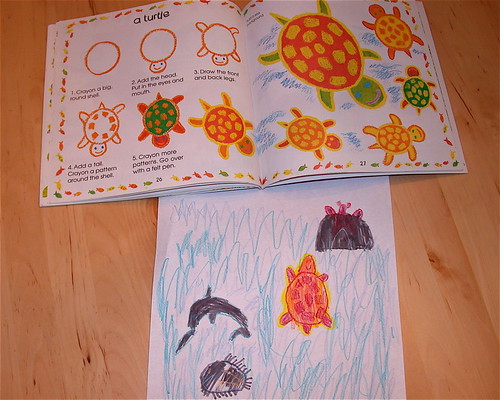
I was reminded again yesterday of how much I love this series by Usborne Books at Home. The series includes I Can Draw Animals, I Can Cut and Stick, I Can Crayon, I Can Fingerpaint, and I Can Draw People. Yesterday Duncan and I spent a good hour with I Can Draw Animals (above). The projects are simple enough that he, age 6, feels a tremendous sense of accomplishment and absolutely no frustration. The drawings go step by simple step, and coloring outside the lines only enhances the final product. Yesterday we did sea creatures; today we are going to draw jungle animals. Being the youngest child, Duncan has not had the benefit of all the hours I poured into his older siblings with art projects. This series if perfect for both of us because of it's simplicity and "around-the-house" usability.

(If you don't have your own Usborne consultant, leave a comment for my friend Donna at her blog and she'll help you out!)

Tuesday, September 25, 2007

Book Review: Helen Keller's Teacher

September 25, 2007

"Teacher, don't talk like that [about your impending death]!" her friend cried out. "You must not leave us. Helen would be nothing without you!"
"Then I would have failed," Annie snapped. For her whole life had been dedicated to making Helen Keller free — free even of Teacher.

I just finished reading this book by Mickie (Margaret) Davidson out loud to Laurel. She could certainly have read it to herself, but I really wanted to share this one with her. I think it was about the 118th time in my life I've read this book about Annie Sullivan, and I still got all choked up. I can think of no other book that I read so often in my childhood. I don't know why this story appealed to me more than the biography of Helen Keller herself, but it was always Annie Sullivan's story that I came back to again and again. The girl with the scratchy eyes and terrible temper, the scenes in the poorhouse, her brother's tubercular hip--all those images were so familiar to me as I read the book to my daughter. And she loved it. I would have been terribly disappointed if she hadn't been enthralled! We have also read Helen Keller's story and watched both the Nest video and The Miracle Worker, but Helen Keller's Teacher is still my favorite.