Showing posts with label writing. Show all posts

Friday, July 17, 2015

Review: Brave Writer's The Writer's Jungle


Math and writing are without a doubt the two subjects that worry homeschooling parents the most. Which? How? When? Should I use this? Do this? Am I doing enough? Too much? Wrong? Why won’t/can’t my kid multiplydivideaddsubtractwriteasentenceparagraphessaypaper??
 

As an English teacher, I am, naturally, regularly asked: what should I use for writing? (Less regularly am I asked "what should I use for math?" In fact, probably never.) This is a surprisingly difficult question for me because there are so many excellent resources out there. Free resources. An abundance of excellent, free resources.  It should be easy to direct people various sites that do a great job teaching the basics: how to write a sentence, how to craft a paragraph, how to succeed with a 5-paragraph essay, how to put a research paper together. What’s the problem?


Confidence— or lack thereof.

Over and over again, I hear parents say, “I am not a good writer. I don’t know how to teach writing.” I hear parents comparing their kid to another kid, even though we all know the mantra “Don’t compare yourselves to others!” Even though we understand in our bones that our friend’s kid is just one of those kids who loves to write, and our kid just doesn’t yet. We all do it.

The bottom line is that we’re afraid of screwing our kids up.


Ahh. Julie Bogart to the rescue. I’ve been advocating Brave Writer for years just because I love Julie’s philosophy. I have always thought that if I were to write a curriculum, it would look like  Brave Writer. Brave Writer offers lots of online courses which look amazing and which I have heard firsthand (from one of my students who wanted extra writing) are superb.

Awhile back I shamelessly begged for a review copy of The Writer’s Jungle because I realized that I really shouldn’t be telling all these homeschooling parents to buy it without having ever actually looked at it. Because, you know. When they asked, “Do you like it?” I would have to honestly reply, “Actually, I’ve never seen it. But I love her philosophy and I feel certain I would love it!” 


OK. Now I have an actual copy of The Writer’s Jungle (thank you, Julie!), and I can say without hesitation: every homeschooling parent should own this, read it cover to cover, and then use it for the duration of their homeschooling years.

First of all, let me clarify that this isn’t a book filled with lesson-by-lesson, “do-this,-now-do-that” plans on teaching your child to write. The Writer’s Jungle takes a holistic approach to the writing process: 
  • providing understanding of how and why for the teacher,
  • giving relief and assurance for the parent, 
  • building confidence for the teacher/parent and student, and 
  • delving into actual writing opportunities.


You will need to commit to reading, underlining, and making some notes in the margin. These are good things! This isn’t the kind of instruction manual that allows you to dig in after a three-page introduction. Bogart has reasons why—and you should read them.


For example, I frequently have moms who say “My son hates to write.” Bogart would be a great comfort to these moms:
“Unfortunately, not all writing problems turn out to be writing problems. Some of our kids are simply throwing hissy fits and need to be told so. By junior high, these fits are especially ugly. Their hormonal bodies give them power. We mothers are first hurt and then angry.

Ruth Beechik reminded me that a lot of writing that started out fresh and unspoiled in elementary school becomes anemic in junior high. Our kids have been in school for years now and are less enamored with the daily grind, I mean, routine. They are savvy enough to think of short-cuts to finishing their school work and balk at being made to put out extra exertion.

Writing requires effort and reflection. Some of our boys, especially, don’t want to engage in that kind of work. They look for quick fixes and entertainment.”

And this one:
 
"The other language arts arena that mothers obsess over is grammar instruction. Just for the record, grammar has very little to do with writing. It has everything to do with understanding the science of language and making sure that you use standard American English when you write. I recommend hitting it three times over the life span of a student: once in elementary school, once in junior high and once in high school."

If you know me, you know how often I recommend exactly that “hit it three times” approach— and how people look at me when I’m crazy when I say you don’t have to pound grammar into their heads every single year forever.

And I love this quote, which is exactly why I don’t like a lot of other writing programs. They produce kids who can write technically correct but extraordinarily uninspired papers:
“Likewise, the report about Vermont that your daughter wrote shouldn’t be a fulfillment of some list of state report topics. It should start there, perhaps, but it must sing in the end. It must have its own quirks, insights and that fresh interpretation that is unique to your child in addition to the evidence of research.” 
So where to start? As Bogart says, “Abandon this constant need to determine grade level. Start out by ignoring writing in its traditional sense. Instead, get interested in your child’s mind.” And this is what she encourages in The Writer’s Jungle: get to know your child, what makes your child tick, and what excites your child. Don’t feel bound by traditional writing methods.

Let me say again: this is not a book of lesson plans. This is a guide to giving a parent confidence, ideas, and many practical exercises for teaching writing. If you’re looking for a program that teaches rote writing, this isn’t it. This is oh-so-much better. I wish every homeschooling parent would read and then re-read it every year or so, using Bogart’s ideas and gaining confidence—and spreading that confidence to their kids.

Below are the Table of Contents pages.

2012 Writer's Jungle


2012 Writer's Jungle


In each of the chapters, Bogart explains/philosophizes (I think of this as her “pep talk” portion) and then gives exercises, examples, ideas, evaluation examples, and more. Here’s an excerpt from Chapter 3 “The Sights Along the Way”:

The “experts” claim to have the knowledge of good and bad writing. Meet the serpents of our imaginations: authors of writing curricula, professional educators, even other well-meaning mothers. We fear that they all say essentially the same thing about us behind our backs. “You can’t teach writing. I’ve seen your child’s work and it’s a joke. I wouldn’t line the cat box with the stuff your kids put out.”… After you worry about how badly you’re missing the mark in teaching your kids to write, these same snakes beguile you with bewitching words: “Listen to me and I will show you the knowledge of good and bad writing.”

You lean closer. After all, writing is central to any good homeschool. And you aren’t secure in your ability to teach it. You listen more intently.…
…The advice of experts, daily repetition and sheer volume will fail you in the end. Once you admit it, you’ll be ready to exit Eden: the land of “Perfect Writing.” West of Eden lies a different landscape altogether, a wild jungle filled with insights, bursts of creativity, bad spelling, unrefined punctuation and surprising metaphors.

There are fewer completed assignments here. Initially the writing will look more like rocks than jewels, but the rocks that are carefully honed into gems become all the more precious as a result. The final papers are compelling to write and read because they come from a living source: the imaginative and powerful minds of children.
 
Later in this chapter, Bogart provides a fantastic series of exercises on using the 5 senses to observe and describe an object. Here is an example of the “smell” and “sound” exercises:


And then later in the chapter, she gives examples of student writing. (This is from “Eli’s observation of meatloaf”) :
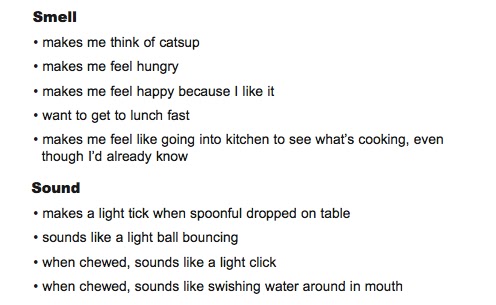
From The Writer's Jungle 2012

This isn’t about developing profound academic writers—although I bet a lot of students will head that way after learning the writing process from The Writer's Jungle. This is about giving kids the tools and practice to be competent communicators. This is about not hating to write—even loving to write! The Writer's Jungle is inspiring, freeing, and confidence-building for parents and students of all ages. 
Want to see how The Writer's Jungle looks in practice? Check out Lora's post on Simple Homeschool about Becoming Brave Writers. Here's a preview: "Before, writing was a subject that caused strife and frustration in our home. Now, writing is our favorite part of the week. It strengthens our relationships, incites conversation, and gives us new ways to entertain and encourage each other."

Other reviews:


If you're intrigued and want to think about getting started with The Writer's Jungle, check out the Getting Started with Brave Writer page. If I were doing this whole homeschooling journey again, I would absolutely use The Writer's Jungle. It would have dog-eared, salsa-stained, highlighted pages with post-it notes sticking out all over the place. 
My final recoomendation: Toss out those boring workbooks and tedious textbooks. It is worth the extra time and effort.

 Be brave!
Before, writing was a subject that caused strife and frustration in our home. Now, writing is our favorite part of the week. It strengthens our relationships, incites conversation, and gives us new ways to entertain and encourage each other. - See more at: http://simplehomeschool.net/writers-jungle/#sthash.69ASZO9P.dpuf


Monday, December 8, 2014

100 Not-Boring Writing Prompts for Middle- and High Schoolers


1. Attach an image (photo, magazine, etc.) to a notebook page and write about it.

2. What things will people in the future say about how we live now? (Examples: They ate that? They believed that?)


3. Pick one from each list to make a creature and animal combination. Now write a short story or scene in which this creature appears.
List 1                                                           List 2
Vampire                                                    porcupine
Ninja                                                            armadillo
Zombie                                                                         pig
Pirate                                                          goat
Mummy                                                     lobster
Clown                                                         possum
Banshee                                                     shark
Wraith                                                        moray eel


4. Imagine a future in which we each have a personalized robot servant. What would yours be like? What would it do? What features would it have?


5. What does your name mean? Free write about names: names you like, names you don’t, how a name can affect a person’s life, how you feel about your own name, why your parents chose your name, etc.


6. Create a brand new holiday with its own traditions, rituals, foods, and activities.


7. What road-trip would you take if you suddenly could? Write about it.

8. List six true sentences that begin with the words “I'll never forget…”


9. Imagine that we lost all electricity, water, and gas for a month without any time to prepare. Write about how your life would change and how you would survive.

10. Make your bucket list for the next 5 years, the next 10 years, and for life.

11. Tell this story: “Well, I thought it was going to be a regular summer doing all our regular things…”


12. List 10 places in the world that you would most like to visit, 10 places you’ve been, and 10 places you would never want to go.

13. Think about hospitality in your family. What’s it like to have guests in your house? Do you prefer to have friends to your house or to go to a friend’s house?


14. Pick a family member of two and write about his or her reputation in your family, or tell a family legend.

15. A guitar pick, a red balloon, and a wicker basket. Write a scene or a poem that includes these three objects.

16. What animal would judge us the most? Write a scene (based on truth or fiction) where two or more people are doing something silly, and they're being observed and criticized by animals.


17. Write about your own worst family vacation memory.


18. Write about your best family vacation memory.


19. Imagine that someone says to you, “Because that's how we've always done it!” Write this out as a scene. (Think: Who said it, what were the circumstances, how did you respond, etc.)


20. What do you think about when you can't sleep? Turn it into a piece of writing.

21. What traditions does your family have? List all of them or just pick one and write about it.

22. Think about your strongest emotion right now (irritation, boredom, happiness, contentment, etc.) and find five quotes about this emotion.


23. What do you struggle with the most? Write about it.

24. Write a self-portrait.

25. What can we learn from contrast?  Write a description of something very dark (like a crow) in a very light place (like a field of snow).  Make the dark thing seem innocent and the light thing seem ominous.

26. Write about someone who has no enemies. Is it even possible? 

27. Think of a person from your past who really deserved a good scolding but never got one.  Write a fictional piece where you tell that person off intelligently.

28. Can honesty honestly be bad?  Write about someone, fact or fiction, who gets in trouble for being too truthful.

29. The word “fat” carries a negative connotation.  Write a story or observation where something fat is celebrated.

30. What animal lives beneath your human skin?  A mouse? A cougar? Or what? Explain with writing.

31. Write about the best piece of advice you ever received.

32. Remember a favorite book from your childhood.  Write a scene that includes you and an old copy of that book you find somewhere.

-->
33.  “I was so mortified, I wanted to crawl in a hole!” Write a short narrative (fiction or nonfiction) where this is your first sentence. Illustrate it if you want.

34. Should books ever be banned? Discuss. If no, explain why. You might want to look at a least of commonly banned books. If yes, explain under what circumstances.
35. Ernest Hemingway said to “write hard and clear about what hurts.” Write about something that hurts, whether it’s an emotional, physical, or phantom pain.

36. What if everyone had to wear a shirt with his or her Myers-Briggs personality type on it? What would this change? How would this affect the way people interact with each other? Would you like this or hate it? (If you don’t know your “type,” try this site.

37. William Shakespeare wrote that: “Conversation should be pleasant without scurrility, witty without affectation, free without indecency, learned without conceitedness, novel without falsehood.” Write your thoughts about conversation, or make up dialogue between two characters who are meeting each other for the first time in an unexpected place.

38. Tell this story: “There it was, finally. Our island. Our very own island. It looked beautiful above the waves of fog, but there was still one question to be answered: why had they sold it to us for only five dollars?”

39. Maya Angelou said “I’ve learned that you can tell a lot about a person by the way s/he handles these three things: a rainy day, lost luggage, and tangled Christmas tree lights.” Tell a story in which a character has to deal with one, two, or all three of these scenarios. How does your character respond?

40. You have a chance to go back and completely re-do an event in your life. What is it, and how to you change it? What is the outcome? This can be a real or fictional event.

41. Pick two characters from different books you’ve read this year and have them get in an argument about something (e.g., who has suffered more, who has had a happier life, etc.).

42. The one shoe in the road: why is it there? Write a story about the circumstances that led to one shoe in the middle of the road.

43. You get to guest star on a TV show. What show is it? What happens in this particular episode?

44. What would you pack in your suitcase if you could not go home again?

45. You can only use 20 words for the rest of your life. You can repeat them as often as you wish, but you can only use these words. What are they?

46. What current fashion in clothing do you particularly like or dislike? Why?

47. Choose five symbols or objects that represent you. Why did you choose these things?

48. "When I stepped outside, the whole world smelled like…" Write a scene that starts with that line.

49. Write a poem entitled "Hitchhiking on a Saturday Afternoon."

50. Use these two lines of dialogue in a story: "What's in your hand?" "It's mine. I found it."

51. Write a scene that happens in a parking lot between a teenager and a man in a convertible.

52. If you only had one window to look out of for the next six months, what would you want to see on the other side? Describe the view. How would it change?

53. Write a story for children. Start with “Once upon a time” or “Long ago in a land far away.” Include a dragon, a deadly flower, and a mask.

54.  "Did she actually just say that?" Write a scene that includes this line.

55. “Call it a clan, call it a network, call it a tribe, call it a family.  Whatever you call it, whoever you are, you need one.” — Jane Howard. Write what comes to mind when you read this quote.

56. List five things you want in a relationship.

57. List ten favorite lines from movies.

58. Write about the biggest mistake you made this week. Now write about the best thing you did this week.

59. What is the very first memory that you have? Write about it.

60. What if your pet could only talk to you at midnight for an hour?

61. Write an acrostic poem using your full name and three words that describe you—good and bad— for each letter. For example, 
S: sensitive, stubborn, smiling.
A: artistic, argumentative, agoraphobic
M: melodramatic, moody, magical

62. What if you could create your own TV show with all your friends and loved ones as the cast? What kind of show would it be and who would play which parts?

63. Take a photo or draw a picture of every place you go in a day. Put the pictures or drawings in your journal.

64. A to Z: Make an alphabetical list of advice for someone who is about to become a teenager. For example: A: ask forgiveness, not permission. B.: bake cookies. C.:  cook something delicious once a month. D: don't compare yourself to others. 

65. Find 10 quotes about happiness.

66.  Write about 5 things you'd rather be doing right now.

67. Write out the lyrics to your favorite song. Find some pictures to illustrate the song.

68. Who do you spend the most time talking to? Siblings, parents, friends? Make a list of who you actually talk to during the day and estimate the amount of time invested in each individual. Does the list reveal your priorities? Is it proportional to what is important to you? Make notes of what you talk about in your daily conversations.

69. Find a quote for each month of the year.

70. Animals can sometimes seem remarkably human. Describe an
experience with an animal that acted in a very human way.

71. Imagine you opted to have yourself frozen for 50 years. Describe your first days unfrozen, 50 years in the future.

72. Imagine that you are an astronaut who has been doing research on the moon for three years. You are do to go back to earth in a week when nuclear war breaks out on earth. You watch the earth explode. Then what?

73. Create a menu from a fictitious restaurant. Make sure the restaurant has a theme, such as Classic Books, and the food should all be given appropriate names (e.g.,  “Mockingbird Pie”).

74. Preconceived notions are often false. Describe a time when you discovered that a preconceived notion of yours (about a person, place, or thing) turned out to be wrong.


75. Create a story using words of one-syllable only, beginning with a phrase such as:
“The last time I saw her, she...”
“From the back of the truck...”
“On the night of the full moon...”
“The one thing I know for sure…”

76. Describe a significant person (teacher, neighbor, mentor, coach, parent, sibling, sweetheart) with as many physical details as possible and as many similes as possible. (E.g., “Her hair was as golden as straw.”)

77. Write about your first name—why you were given it, what associations or stories are attached to it, what you think or know it means. Do the same for your last name. What name would you give yourself other than the one you actually have?

78. Parents are our first and most important teachers. Describe  a valuable lesson you learned from one of your parents.

79. Imagine a moral dilemma (for example, you see someone shoplift or a friend tells a blatant lie to her parents about where she was last night) and explain what you would do and why you would do it.

80. Review an obituary, birth, or a section from the police record or classified ads section of a local newspaper. Choose one and tell the story behind it.

81. List the most attractive things about your current hometown. Now list the most unattractive things.

82. Come up with a list of nouns and a second list of verbs, all of one syllable each. Describe a scene or situation, using a minimum of ten words from each list.

83. Where is your happy place? Write about it and include a picture or drawing.

84. Create a how-to manual for something you can do well (make a craft, bake cookies, restring a guitar, apply make up, etc.). Describe the process so that someone else could complete the task based on your directions. Use present tense verbs.

85. Free write on this quote by Samuel Johnson: “Ignorance, when voluntary, is criminal.”

86. Find  a favorite quote and work it into an illustration. (Inspiration here.)

87. Make a soundtrack for your life so far. List songs that describe you or different times of your life. (Make the actual soundtrack on Spotify, etc. too!)

88. Sometimes we find ourselves in situations that force us to face our deepest fears. Tell about a time when you had to face one of your greatest fears—or make up the story.

89. You’re a talk show host. Pick two guests. Why did you choose them? Are they people who get along, or people with vastly different viewpoints? Write about the episode.

90. What three books do you think should be required reading for everyone? Why?

91. “What you don’t know what hurt you.” Write a story that begins with this statement.

92. Free write on this quote by Woodrow Wilson: “Friendship is the only cement that will hold the world together.”

93. According to a Czechoslovakian proverb, “Better a lie that soothes than a truth that hurts.” Agree or disagree? Explain.

94. Rewrite “The Tale of the Three Little Pigs” by using people that you know as the pigs and the wolf.

95. There is a saying that you should be careful what you wish for, because you just might get it. Describe a time when you wished for something and got it—and then wished you hadn’t—or make up a story in which this happens to the character.

96. As the saying goes, “rules are meant to be broken.” Tell about a time when you broke the rules and what happened as a result.

97. "That's not what I meant!" Write a story that has this line in it somewhere.

98. A blue trash can, a red picture frame, a teddy bear with the stuffing falling out, and a padlock. Put these four items somewhere in a story, scene, or poem.

99. Write your name in outline letters on a whole sheet of paper. Now fill in each letter with words you like that begin with that letter. For example:


100. Make a word collage of who YOU are. Use pictures too, if desired.


**HURRAH! You can now purchase this as a digital PDF ($2) at Teachers Pay Teachers.


For more creative writing ideas, check out my free WordSmithery creative writing lessons and my popular Ultimate Guide to Creative Writing Resources!


Check out 100 other 100 Things posts from the bloggers at iHomeschool Network!


Do you have it yet?  The Big Book of Homeschooling Ideas—a collaboration of over 50 authors with 103 chapters— is now available! Don't miss this amazing resource!


Thursday, February 27, 2014

Teaching The Book Thief: Repurposed Pages

Because The Book Thief movie was recently released, I decided to include the book as part of my World Literature class this year. I am so glad I did! Most of the kids absolutely loved this book, and we had fantastic discussions, ranging from Hitler Youth to banned books to the incredible power of words.

The Book Thief is all about words and books, hatred and beauty, death and the capacity for survival. I found lots of activities on the internet for this unit, but my favorite came from The Picky Girl, who ripped pages out of a book, handed each student a page, and had him or her repurpose the page in some way. I tweaked her plan to better fit my classroom, and I was absolutely thrilled with the results.

At home, I ripped pages out of a book. This was a little hard for me to do, particularly after a riveting discussion we had in class about book burning. Some kids maintained that it was OK to burn books that were of no value to them, some said that it was never OK to destroy a book, and a few said they didn't care either way. Oh, and several insisted that if there was a zombie apocalypse, they would not hesitate to burn a book for fuel or use it for toilet paper.

I will confess that it was a Chicken Soup for the Soul book out of which I ripped pages, and it really wasn't that hard to do. (The greater problem for me was pondering why we even had one on our bookshelf.) I ripped the pages out ahead of time rather than doing it for shock value in front of the class. I didn't think they would be particularly shocked, and also I needed to make sure that the pages were G-rated. (Censorship while teaching a book about words. I know.)

In class I handed each student a page with these instructions:

-->
Your assignment this week, besides finishing the novel, is to repurpose your book page.
The Book Thief is largely a book about the power of words: how words can harm, heal, destroy, or build up. How words can be manipulated, ignored, reclaimed for a different purpose, grasped, and cherished. Max, for example, makes something beautiful out of Mein Kampf.
Writers use a variety of techniques to bring their written words alive for the reader. Zusak particularly uses a lot of similes, metaphors, and personification to hit his readers with vivid images.

Your job is to take a quote from the novel and interpret it creatively from your mind’s eye onto paper. You don’t have to be artistic at all. You can do this in a variety of ways. For example:
• paint over the page like Max did, write the quote, and use some kind of visual illustration. This can be your own drawing or something you cut out from a different source and attach to the page.
• black out words on the page except ones that have to do with your quote. Put the quote on the page in some way.
• Use your page as a frame for the quote, or cut your page out into an image.

#1 Rule: don’t be silly. I really want to see what kind of connections you can make with a quote, a page of words, and your knowledge of the book. Below are several quotes, but you absolutely can use other quotes or phrases from the book.

I included about 20 quotes from the book as ideas, but, as I said in the directions, they could choose their own quotes from the book. I had to include the "don't be silly" part because, well, I knew that one or two would consider this to be a blow-off assignment. 

Here are just a few of their pages:


Instead of using the page, this one took an old dictionary and repurposed it.


This little book actually opens and has a story for the book in it. How cute is that?


How awesome is this? He used his guitar as a canvas for the page. And this is a kid who says he really doesn't like reading.


I was positively thrilled with the results. Most of the kids put a lot of thought and creativity into the project. I wanted them to have a hands-on experience with how words can be manipulated, highlighted, and played with, and they totally pulled through.