Showing posts with label book reviews. Show all posts

Wednesday, April 5, 2023

January-March in Books

  I've finished 23 books so far this year. I've started listening to more audiobooks this year, and not only have I enjoyed them tremendously on my daily walks, but they are adding to my monthly totals, for sure. Here are comments on several of January's books.


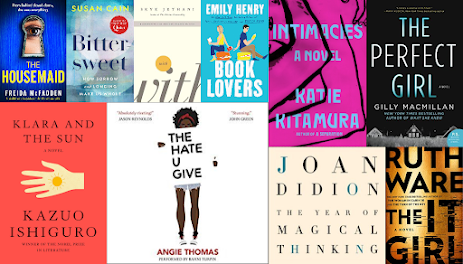
The Perfect Girl by Gilly Macmillan. 4 stars. This thriller not only kept me on the edge of my seat, but the last quarter was also satisfying —something I find to be rare in thrillers.

The Hate U Give by Angie Thomas. 5 stars. This is an incredible novel about the fatal shooting of Kahlil, a Black teenager by a white police officer, told from the POV of Starr, the teenaged girl —the Witness—who was with Kahlil. Highly recommended novel about racism, injustice, balancing worlds, friendship, and finding your voice. Actress Bahni Turpin read this audio version, and she is phenomenal.

Intimacies by Katie Kitamura. 3.5 stars. The narrator is an observer of intimacies and a passive participant in her own moments of intimacy. She watches small dramas play out without jumping in. As an interpreter at The Hague, she has to carefully translate details of horrific war crimes while remaining stoic. I liked this novel—the prose is lovely and concise—but it left me feeling somewhat cold, all the while hoping that the unnamed narrator finds the warmth she seeks.

The Housemaid by Freida McFadden. 3 stars. Psychological thriller that’s perfect for in between heavy reads. A rich psychotic family, a hot Italian groundskeeper, and an ex con. What more could you want?

The Year of Magical Thinking by Joan Didion (audio). 4 stars. Phew. So sad, so beautiful. Hard to listen to because it’s so sad.

The It Girl by Ruth Ware. 4 stars. Good mystery!

Bittersweet by Susan Cain. 3 stars. An interesting study of the importance of embracing loss and sorrow rather than putting on a brave face all the time. As someone who is completely comfortable with and aware of the bittersweetness of life (I mean, I write poetry!), I did not find this revelatory, but it was affirming, which is always a plus.

With — finally finished. Unremarkable.

Klara and the Sun by Kazuo Ishiguro. So good! A story of Klara, an artificial friend, and her girl, Josie. This one stayed with me for a long time, and I still think about it now and then.

Book Lovers by Emily Henry. Very cute. I love Emily Henry.

Memphis by Tara M. Stringfellow. Audio book. Outstanding. Some difficult parts but so excellent. Three generations of women growing up in Memphis. Four stars.


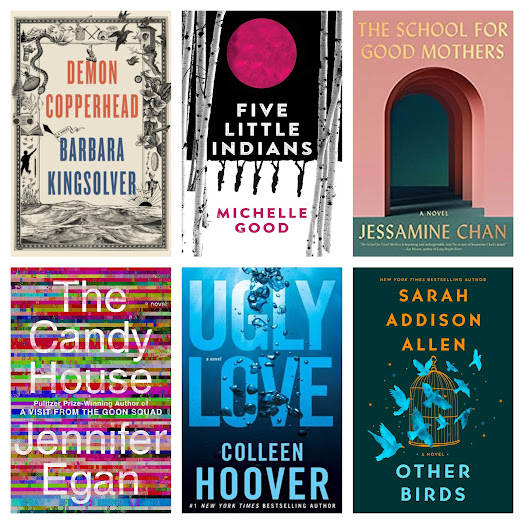
February and March were excellent reading months. I may never recover from Demon Copperhead. I can't imagine that anything else could possible take over its Number One spot in 2023!

A few comments...
1. Demon Copperhead YES YES YES. Five hundreds stars. Totally lives up to all the hype and more. I recommend watching the limited series Dopesick (8 mesmerizing episodes) on Hulu and then reading Kingsolver's novel. Wow.

2. Ugly Love is my first Colleen Hoover book, and may be my last. I needed to know what the buzz is about Colleen Hoover. This was a very fast read. Most of the characters were pretty flat, the plot was fairly predictable, and it all tied up happily. I think Emily Henry and Taylor Jenkins Reid are infinitely better writers with much more original and interesting stories. 

3. The School for Good Mothers is an excellent book to pair with Celeste Ng’s Our Missing Hearts. In this one, a newly single mom has a single bad afternoon that leads to her being arrested and sentenced to a year at mother-training school. So good. And scary.

4. The Candy House: I really liked this Egan's novel; however, this is the kind of book that should be read in a few long sessions rather than over the course of a week or two, 15 minutes at a time, like I did. It’s also probably better read in hard copy rather than on an e-reader There are so many characters in this nonlinear book, and they are all connected in various ways. I would forget from night to night who a particular character is that was mentioned 80 pages beforehand, and I’m too lazy to flip back through my Kindle to find out who this person is. Really intriguing book but would have been greatly enhanced and appreciated if I’d read it in a few sittings.

5. Five Little Indians: A painful book. The topic is so important and the story needs to be told, but the prose was choppy and stilted. This seemed like a first draft and needed the help of a good editor. Again, this is an important story and worth reading on a humanitarian level, but I wanted the storytelling itself to be so much better.

6. Other Birds: A sweet, happy book that I obviously needed after all the heavy reading. Lovely.

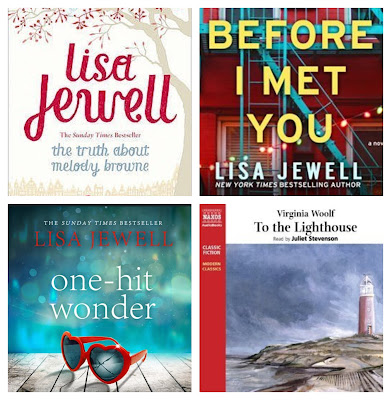
7. Audiobooks: Clearly I was on a Lisa Jewell kick, and I don't regret the many miles walking with her mysteries. She's mesmerizing. Also listened to the classic Virginia Woolf To the Lighthouse, which is of course, well, amazing and unforgettable. It's better to read in print so you can underline everything, but however you consume it, consume it.

And there we have January-March in books.

What are you reading that I should add to my never-ending TBR list?

Also please explain the Colleen Hoover craze. No judgment if she's your thing; I'm just trying to figure out why there is so much hype about her books!


Saturday, June 4, 2022

Books Read in May


Rock Paper Scissors by Alice Feeney. 


This was a fun psychological thriller. Lots of secrets and some fun plot twists with plenty of eye-rolling moments. Not a masterpiece but a good in-between read.


The Woman They Could Not Silence by Kate Moore. 


Subtitled "One Woman, Her Incredible Fight for Freedom, and the Men Who Tried to Make Her Disappear," this is the nonfiction story of a mother of six in the mid-1800s whose husband, a Presbyterian minister, decided she had way too many opinions. And so, because he could, he committed her to the asylum. After all, she had the audacity to challenge his religious and political beliefs; thus, she was clearly insane. The author uses the letters and journals of Elizabeth Packard in telling her incredible story of fighting not only for her freedom, but for justice for women incarcerated by their husbands across the U.S. This was an amazing story, both frustrating and inspiring, and the short afterword reminds us that “difficult” women continue to be silenced.  Highly recommended!


The Reading List by Sara Nisha Adams. 


This will definitely be a contender for my favorite book of the year. A series of people in a community find a list: “In case you need this” with a series of book titles. The titles draw them to the library, where they all interact at some point, and as they read, they find healing and connection. I laughed, I cried, I wanted to curate my own reading list and stuff it in mailboxes, slide it into library books, and pin in on bulletin boards. 


What would be on my reading list? What would be on yours? Great fodder for a book club discussion!


Friday, April 16, 2021

Books Read in March


 Anxious People by Fredrik Backman.

"…We all have this in common, yet most of us remain strangers, we never know what we do to each other, how your life is affected by mine. When this day is over and the night takes us, allow yourself a deep breath. because we made it through another day."

The story: A bank robber. A man who jumps off a bridge and the girl who doesn't. A real estate agent, a couple of cops, and a few people in and out of love. Mothers and fathers. Lovers and lost loves. This beautiful, tender novel features a cast of characters who are accidentally held hostage and who hold themselves hostage with secrets too painful to share. Their anxiety is palpable... but sometimes, when you share just a little bit, the anxiety can be relieved, and hope can be restored —if everyone works together. 

My reaction: Fredrik Backman does it again. HOW DOES HE DO IT? Once again, Backman took me by surprise, made me fall in love with characters, and got me all choked up. This novel took me a little bit to get into but once I did, well, I never wanted it to end. His rhythm and pace, as well as the connectedness of the stories, reminds me so much of Markus Zusak's The Book Thief, which is one of my all-time favorite books. 


The Lions of Fifth Avenue by Fiona Davis

The story: Laura Lyons and her family live in the NYC Public Library, where her husband is the superintendent. They seem to have a wonderful marriage, and then Laura decides she simply must pursue her journalism degree; her husband suggests she wait a year until their finances are better. Suddenly, she sees him in a new light. He's holding her back, and she pursues the degree anyway. She meets a whole new crowd as a result of journalism school, and her life changes. In the meantime, books are missing from the special collections at the library, and her husband is blamed for the thefts. The second story alternates chapters with this one. Sadie works at the library

My reaction: I love the setting of this novel. Imagine living inside the NYC Public Library! Fans of From the Mixed Up Files of Mrs. Basil E. Frankenweiler know what I'm talking about. This novel has a lot of the same issues I complained about in last month's book club novel also by Fiona Davis, The Dollhouse. It's jumbled. We're here and then we're there and squirrel! Way too much isn't explained. The dual stories are better connected in this one, for sure. Davis starts strong, but ultimately way too much happens, the characters are poorly drawn, the action is outrageous (way too many coincidences, for one), and her messages seem didactic and yet confusing and contradictory. I did enjoy the peeks into early 20th century feminism as well as the book trade, but otherwise... too much eye rolling and "what just happeneds??" going on in my head. 


The Reckoning by John Grisham (audiobook)

The story: Small town Clanton, Mississippi's local war hero and respected resident Pete Banning kills the pastor. And 18 hours later, we find out why. In the 16 hours between the killing and the big reveal, we get the complete story of Pete Banning, including an entire extremely detailed section on his wartime experience in the Philippines, his courtship and marriage; plus every detail of his son Joel's life (loved his meeting with Faulkner), a little on his daughter, and lots on his wife. 

My reaction: I have John Grisham issues. I've written about this before, and yet I keep going back to him. This time, we listened to this as an audiobook all the way to Florida and back and then a few more hours even. 18 hours of a story that could easily have been half that long. I mean, Grisham is a great storyteller. He is terrific at building and maintaining suspense. We cared about these characters. We were sucked in, waiting for the great reveal. Which was... a big thud. A big Are you freaking kidding me? Ugh. So much wrong with the big reveal. I won't say what it was, but it was not only disappointing but terribly trite. It was just an old, old story that needs to stop being told. Randy and I felt like Grisham really wanted to tell the story of the Bataan death march, which is the whole middle section of the book. It was interesting, for sure, but it was absolutely not necessary. Grisham is so good at nonfiction; in my 2007 review of An Innocent Man I wrote that "Grisham needs to pursue writing nonfiction a little more often," and I'm sticking with that. Why not write an actual account of one of the survivors of Bataan, rather than squeezing this in with this novel? Anyway, I felt ripped off at the end of this novel, as well as annoyed throughout for many reasons, but particularly for Grisham's stereotypical, rude treatment of Black characters. (He actually uses the term "colored." For real. But there's so much more.) Also, for the last few hours, we were rolling out eyes at all the completely extraneous details and shouting "GET ON WITH IT, JOHN!" My recommendation: skip it.


The Survivors by Jane Harper

The story: After a decade away, Kieran returns home to his tiny coastal village in Tasmania to help his parents. His father is struggling with dementia, and it's time for them to pack up and move into assisted living. Kieran left for a good reason: the summer after he graduated from high school, a huge storm struck and lives were lost —because of him. When he heads into the local cafe with his wife and newborn daughter, he can feel all eyes upon him, accusing him. And then tragedy strikes again, and as the townspeople and official investigate this new murder, all kinds of secrets surface.

My reaction: I absolutely loved this book. This is my introduction to Jane Harper, and I will definitely be reading more. Reviewers seem to like this one a bit less than her others, so I'm super excited to read The Dry, Force of Nature, and The Lost Man, too. Harper is a wonderful writer. Her characters are richly drawn, her dialogue spot on, and the mysteries about what really happened were revealed slowly and satisfyingly. I love the long ending. So many books I've read lately reduce the ending to a quick wrap-up, as if the writer herself got tired of the book and declared, "I'm done." Not so with The Survivors. This is everything I love in a book: a long story with plenty of backstory, a setting that acts as another character, a true mystery, excellent writing, strong and likable characters, and just the right amount of tension. Highly recommended. 


Fierce, Free, and Full of Fire by Jen Hatmaker

The story: Subtitled "The Guide to Being Glorious You," this is a "embrace who you are,"  "you can do it" and "we're all in this together" book. It's divided into five self-reflective categories: who I am, what I need, what I want, what I believe, and how I connect. The chapters within those categories explore strategies, offer stories, and provide encouragement for navigating who we are and feeling exuberant (or at least okay) with that. This is listed as "Christian Women's Issues," but the theology is light-handed but extremely refreshing. 

My reaction: We chose this book for our small group (six women) over the past year -- pandemic year. At first, we were all super excited and found relief and connection in this book. We loved the dismantling of what it means to be a "Christian woman." We loved knowing we aren't alone in our questions and searching. Ten months later, we were all thrilled to be done with it. I don't think that's a reflection on the book or Jen Hatmaker. I think we transitioned, as the rest of the world has, from exploring ourselves to being sick of exploring ourselves! Toward the last third of the book, sick of Zoom and longing for normalcy, we became annoyed with Jen's cheerleading and capital letters and LET'S GO GIRL rah-rahs. Somehow, at the end of a year of isolation, perhaps it's been difficult for us to connect with who we were pre-pandemic. Our values have shifted. Our inner eye is tired. I also think this book would be much more appreciated by women in their 30s-40s, and we are all in our mid-40s and 50s. Also, I don't recommend spreading this out over nearly a year! This could be a quick read but a kind and thoughtful one, if read at the right time in one's life.


When We Believed in Mermaids by Barbara O'Neal

The story: Sisters Josie and Kit has a terrible and wonderful childhood. Their parents, free-spirited restaurant owners, were so obsessed with their own lives that they completely neglected their daughters, who ran wild on the California beaches. Fortunately, they have Dylan, an informally adopted older brother, to keep them straight, help them with their homework, teach them to surf, and basically care for them as if he were their parent. And then tragedy strikes when an earthquake completely shakes up their lives. Nothing is ever the same after the earthquake. The sisters drift apart, and Josie dies in a terrorist attack on a train Or does she? One day Kit and her mother see a face on a screen that looks exactly like Josie, and the search begins. 

My reaction: I absolutely loved this book. O'Neal does a masterful job of revealing the story bit by bit through flashbacks interwoven with the current day story of Kit and Josie. Each character is carefully, lovingly developed. I was rooting for both sisters -- I wanted Kit to find Josie, and yet I wanted Josie to be able to keep the beautiful new life she'd made for herself. Honestly, I was just utterly wrapped up in the entire story and was so sad when it was over. Some of the issues in the book are hard, but it is well worth the emotional investment. Highly recommended.


The Wife Upstairs by Rachel Hawkins

The story: The is a modern-day retelling of Jane Eyre. Jane falls in love with Eddie. Eddie has a secret wife, well, upstairs. And so the story goes.

My reaction: Honestly, I tend to steer clear of retellings of classic stories.  Jane Eyre is one of my favorite novels ever, so I probably would not have picked this up had I realized what it was about. But... I liked it! As a true Jane Eyre fan, I appreciate all the characters being included: the insipid St. John Rivers shows up as John Rivers, Jane's sniveling, sneaky roommate. Rochester's daughter, Adele, is Eddie's dog in this version; Jane is the dog walker. In fact, she's the dog walker for all of Thornfield Estates, the ritzy subdivision. I thought Hawkins' reimagining was fun, and there are a few twists that made me smile. I would actually recommend this for fans of Jane Eyre, if you're up for a playful adaptation.  


Love, Life, and Elephants by Daphne Sheldrick

The story: This is Daphne Sheldrick's lovely memoir of growing up in Kenya, from her early childhood to her many years as the warden's wife of Tsavo Park, a wildlife refuge. Sheldrick was a mother to hundreds of animal orphans, from a weaver bird to a mongoose to rhinos and, most famously, as an elephant keeper. She is the first person to ever successfully raise an orphaned baby elephant to adulthood. Woven in with her animal tales are her people tales -- her loves, her losses, and her friendships. 

My reaction: This is a book I would probably never have read on my own— and that's why book club is so wonderful! I absolutely loved this sweet memoir. I listed to this one, and Virginia McKenna is an absolutely delightful narrator. I was utterly wrapped up in Daphne's life, rooting for the animals, rooting for her. You can't help but fall in love with each animal and with Tsavo Park and, of course, with Daphne. She had an incredible life and shares that with her readers so beautifully. I learned so much about all kinds of African animals! I don't know that I would have enjoyed the book quite as much if I'd read it; I think McKenna's narration feels as if Daphne herself is telling the tale. Highly recommended! 


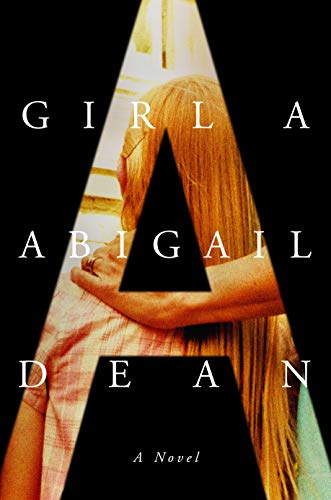
Girl A by Abigail Dean

The story: Lex is the girl who escaped the House of Horrors. Once identified by the press and police only as Girl A, she's now a successful attorney, trying to live a normal life. But her past haunts her; how could it not? She and her brothers and sisters grew up in utter poverty, starved, neglected, isolated, and, ultimately, held captive by their parents. She wants only to forget it all, but when her mother dies in prison, Lex is appointed executor of the estate. She has to go back and face her story, her childhood home, and her fellow captives: her six siblings. Each of their stories — during and after their childhood — is different. Each has coped in a different way, and their bonds to each other are tenuous and complicated.

My reaction: I absolutely loved Dean's debut novel. It was emotionally tough to read at times (OK, most of the time) because the subject matter is unthinkable, but it's utterly engaging and so well written. Abigail Dean handles the story with grace, allowing these fictional siblings their dignity and giving the reader enough detail to let us see the horror but without going into extraneous, over-the-top description. This is somewhat along the lines of Educated, Tara Westover's memoir. Although this is a work of fiction, we all know that horrors like this do occur. Highly recommended.


Wednesday, March 17, 2021

Books Read in January and February

Books Read in January 


 The Girl with the Louding Voice by Abi Daré

The story: Adunni is a fourteen-year-old Nigerian girl who wants two things: her mother, who was her greatest advocate, and an education. She can't get her mother back—she has passed away—but she is determined to get an education. This, her mother told her, is how she gets a "louding voice"—how she can speak for herself and determine her own path. Adunni lives in a traditional village in Nigeria, under traditional tribal laws. When her father pulls her out of school and trades her to an old man as his third wife, her dream of an education looks impossible. She faces daily abuse, drudgery, and fear, and then tragedy strikes. She makes a bold decision that saves her life and ultimately leads her to a new one. 

My reaction: This was a perfect book with which to begin a new year. Adunni is the most wonderfully courageous young woman. She is compassionate, gutsy, curious, intelligent, and determined. The story is told through her voice, which makes this even more compelling, inviting the reader right into her world. In her words:  “I want to enter a room, and people will hear me even before I open my mouth to be speaking. I want to live in this life and help many people so that when I grow old and die, I will still be living through the people I am helping.” I loved the wide array of women introduced in this novel, each with a different voice and a different experience. Some of their voices are muffled, some completely shut, some shouting, but each one cries out in some way for understanding. Highly recommended!


Caste: The Origins of Our Discontents by Isabel Wilkerson

The story: Isabel Wilkerson explores the characteristics of caste systems, the way human beings are ranked, and shows how the United States is rooted in a brutal caste system that puts Black Americans firmly at the bottom of the ladder. She compares and contrasts the U.S. caste system with that of Nazi Germany and India. As she writes, 

"Throughout human history, three caste systems have stood out. The tragically accelerated, chilling, and officially vanquished caste system of Nazi Germany. The lingering, millennia-long caste system of India. And the shape-shifting, unspoken, race-based caste pyramid in the United States. Each version relied on stigmatizing those deemed inferior to justify the dehumanization necessary to keep the lowest-ranked people at the bottom and to rationalize the protocols of enforcement. A caste system endures because it is often justified as divine will, originating from sacred text or the presumed laws of nature, reinforced throughout the culture and passed down through the generations." 

My reaction: I think every single American should read this book. We need to be talking about this, teaching this in our schools, and working toward demolishing the American caste system. As Wilkerson writes (italics mine), 

Americans are loath to talk about enslavement in part because what little we know about it goes against our perception of our country as a just and enlightened nation, a beacon of democracy for the world. Slavery is commonly dismissed as a “sad, dark chapter” in the country’s history. It is as if the greater the distance we can create between slavery and ourselves, the better to stave off the guilt or shame it induces. But in the same way that individuals cannot move forward, become whole and healthy, unless they examine the domestic violence they witnessed as children or the alcoholism that runs in their family, the country cannot become whole until it confronts what was not a chapter in its history, but the basis of its economic and social order. For a quarter millennium, slavery was the country. 

Wilkerson uses stories about real people —including her own experiences— to show how insidious and pervasive the caste system is in America -- how it seeps into every aspect of our lives. I highlighted about a billion passages in this book. I had to put it down sometimes and just mull over what I'd read. Wilkerson is a wonderful writer, using just the right balance of personal experiences, analysis, and research, both historical and scientific. (At one point I shouted to my husband, who has a PhD in genetics, that I was reading about telomere length and understanding perfectly!) This book is a lesson, a reprimand, a call to action, a plea, and a challenge.

"Each time a person reaches across caste and makes a connection, it helps to break the back of caste. Multiplied by millions in a given day, it becomes the flap of a butterfly wing that shifts the air and builds to a hurricane across an ocean."


The Bookshop of Yesterdays by Amy Meyerson. 

The story: Miranda's favorite uncle dies and leaves her his independent bookstore. Well, that's the simple way to explain the book. But Miranda, now in her late 20s,  hasn't seen her uncle since she was 12-years-old, when he disappeared from her life without explanation. Her mother, his sister, won't talk about Uncle Billy. Her father just says, "Ask your mother." And the bookstore is on the opposite coast, far away from Miranda's current life as a high school history teacher. When Miranda returns for his funeral, she realizes his inheritance comes with a scavenger hunt. In order to solve the mystery of why Billy disappeared from her life, she has to follow the clues and put the whole story together: “Like Prospero, Billy wanted to tell me of his betrayal, the event that had exiled him from our family." And so the search begins, taking Miranda from person to person, event to event.

My reaction: Boy, did I ever need this one after reading Caste! This is lighthearted (mostly), warm, happy (mostly), quick read. This is a book lover's book, for sure. I love all the titles listed throughout, the literary references, the celebration of reading. And what a DREAM: to inherit a whole bookstore! Meyerson does a fantastic job immersing us in the world of bookstores—I could smell the books, feel the covers, and take comfort in the shelves. Miranda herself was a little annoying now and then, but certainly not enough to keep me from highly recommending this.

My biggest gripe: the title. I cannot remember this for the life of me! Shakespeare's The Tempest was such a prevalent theme throughout the book—Prospero Books and the name Miranda, just for starters. Why not use Prospero in the title? (Or maybe the title IS a reference from The Tempest, and I'm not getting it! "Dreamers of tomorrow and yesterday," perhaps...)  I keep getting this title mixed up with others I've read recently: The Little Paris Bookshop, The Library of Lost and Found, The Book of Lost Friends... I know—it's a petty complaint and should not stop anyone from reading this lovely book!


My Dark Vanessa by Kate Elizabeth Russell

The story: Vanessa is an outcast at her boarding school. She's lonely, friendless, isolated, and 15. She's the perfect prey for a predator like her 40-something English teacher, Mr. Strane. He singles her out and grooms her carefully, telling her that she's just like him, that he's madly in love with her, that she's brilliant. He knows all the right things to say, knows exactly how to manipulate Vanessa. Over 15 years later, he still knows all the right things to say: he knows how to convince her to keep their story quiet when another young woman, and then another and another come public with accusations of being abused by Strane. "They're lying," he tells Vanessa, and she believes him. He has been telling her since she was 15 that she's special, after all. The book alternates between 15-year-old Vanessa and Vanessa in her early 30s, when the accusations are flying about Strane. It's the #metoo movement, and Vanessa claims she is NOT a victim: that she made all her own choices, willingly. How long will she keep protecting her abuser?

My reaction: Haunting. Disturbing. Unsettling. Brilliant and brave. My heart absolutely broke for Vanessa, over and over again. This book is full of triggers, so beware. It is a difficult, gut-wrenching journey. To read how a 15-year-old is brainwashed, manipulated, and degraded by an authority figure is just so heartbreaking and maddening. I was angry at her parents for treating her like a leper, for the school for not pursuing the initial report of abuse, and of course for Strane for being a despicable pedophile. But I was never angry with Vanessa, who was so deeply twisted by Strane that she could not see the truth of their "relationship." This book is not for everyone, for sure. It is raw, graphic, and so disturbing, but Russell does an incredible job of inviting the reader to explore the complexities of abuse, the thread between abuser and the abused, the voiced and the voiceless. Highly recommended but know ahead of time: this is hard stuff.


The Dollhouse by Fiona Davis.

The story: Rose is a 30-ish journalist who has recently moved into the once glamorous Barbizon Hotel for Women, now luxury condos, with her partner. She becomes intrigued by the older women who live on the fourth floor of the hotel—women who are long-term tenants, now living in rent-controlled apartments. She learns that one woman fell to her death in the 1950s, another has a terrible scar on her face from some kind of altercation. Rose pitches the story to her editor and starts interviewing these women. From there, the book alternates between Rose's present day story and the story of Darby, one of the Barbizon women in the 1950s. 

My reaction. The first half of the book was great... and then it fell apart. Darby's story just took too many unrealistic turns, and Rose's story never reached much development after the first half. I mean, she thinks she is about to get engaged, and then her boyfriend leaves her for his ex-wife. Exit long time almost fiancé, enter new guy. She's over her ex really fast. And there were a lot of references to what "really" happened at her previous job, but it just seemed extraneous and distracting. Darby's 1952 story could have been so much more interesting had it been given more attention. The characters there held promise. It was as if too many stories were happening at once, and none of them made it to a satisfying conclusion. Honestly, the book just went on way too long, and the climax was like a balloon that slowly and limply deflates. 

Linked up with It's Monday! What Are You Reading?


Books Read in February 

 Woman 99 by Greer Mcallister

The story: It's the mid 1800s, and Charlotte's beloved older sister, Phoebe, suffers from what appears to be bipolar disorder. Her parents commit Phoebe, who they consider to be an embarrassment to the family, to an insane asylum. Charlotte absolutely cannot let Phoebe rot away there, and she hatches her own insane plan: she'll get herself committed to the asylum so that she can bring Phoebe home. By appearing to be suicidal, Charlotte gets sent to the asylum. She is shocked and horrified to discover that many of the women have been committed merely because they were somehow not "proper" women: they suffered from postpartum, loved the "wrong" person, or perhaps their husbands were just tired of them. She learns their stories while searching for Phoebe, and she also considers her own life and pending wedding.

Willard

My reaction: I've always been both drawn to and terrified of books about asylums. The tension is real! I grew up on Seneca Lake, roughly across and down some from The Willard Asylum for the Chronic Insane, and Willard, as we called it, loomed largely in our young imaginations. I used to terrify myself by imagining that an escaped inmate would row a boat across the lake and land on our beach. Anyway... it's always been a strange fascination of mine. The thought of Charlotte willingly entering an asylum was both fascinating and unbelievable to me. I enjoyed very much the descriptions of the various wards, each focused on a different "ailment": love, silence, oversexualization, melancholy, etc. And I loved that Charlotte quickly recognizes that so many of the women in the asylum are there simply because they are inconvenient in some way. This is basically storage for women who dare to buck the system. There were definitely times that the book was too repetitive and drawn out, and some scenes seemed quite implausible; however, I found the book ultimately satisfying. For a book about an asylum, it was not graphic nor horribly disturbing. Recommended! 


The Dutch House by Ann Patchett

The story: This is a marvelous story of a brother, a sister, and their rightful inheritance, the Dutch House, a grand house purchased by their father and ripped out from under them at his unexpected death. For the rest of their lives, Danny and Maeve try to figure out what went wrong and how to get it all back. They move forward with their lives when they are apart, but each time Danny and Maeve get together, they pick apart every detail of the events that led up to their father's death. Other people in their lives fill in details now and then, and as they leave middle age, the siblings finally have some closure as questions are answered.

My reaction: Ann Patchett is just the real deal. What a storyteller! Everything about this works together. There are no loose ends, no wondering for me. The characters, including the house itself, are all richly drawn. It's somewhat of a Hansel and Gretel tale, with an evil stepmother, a kind but distant father, and that irresistible gingerbread house that draws them back again and again. I love Ann Patchett, and I love this book.


After Alice Fell by Kim Taylor Blakemore

The story: It's just after the Civil War, and Marion has spent the past year as a battlefield nurse. While she was gone, her beloved sister, Alice, was committed to an asylum by their brother and his wife. And then Alice fell off the roof of the asylum and died. Everyone assures her that Alice committed suicide, but Marion knows she would never do that. So how did Alice get to the roof, and who pushed her? Let it go, her brother and his wife tell her, but she cannot rest until she finds out how Alice fell.

My reaction: Eh. Well, first I have to say how weird it is that I read yet another book this month set partially in an asylum in the mid-1800s. Between this and Woman 99, the latter is far more interesting. This one had so many missing pieces. It was terribly disjointed, and at times I felt as if I were in an institution. None of the character, except the dead Alice and the nephew, were particularly likable, and I like books with likable characters. I'd give it a solid 3.5. 


The story: Lucia and Miranda are Chinese-American sisters, fiercely loyal to each other. Miranda, as the elder sister, is protective and motherly toward Lucia, who is carefree and impulsive, a girl who thoroughly enjoys each moment of life. Both sisters are independent and brilliant, but as Lucia heads into her 20s, she develops a mental illness. Only Miranda knows about it for awhile, until Lucia marries Yonah. Within the first year of their marriage, the "serpents" begin tormenting Lucia. The voices in her head drag her down, and Miranda is there to rescue her. Their relationship suffers, as Miranda becomes more and more insistent that Lucia take her medicine, and Lucia resists. Lucia spends the next decade or so in and out of hospitals, in and out of relationships, and in and out of motherhood. Miranda is walks the tightrope of caring too much and letting go.

My reaction: What are the chances that I would read yet a third book centering on two sisters, one of each pair with a mental illness, in the span of a month? This was totally not on purpose; I just grabbed the books when they became available on the library's electronic reading system. This is my favorite one by far. This book is so beautifully written. Each of the characters — Lucia, Yonah, Manuel, Esperanza, and Miranda — is richly brought to life. We are especially submerged in Lucia's world— from vibrant and then impoverished neighborhoods in NYC to rural Ecuador. Lee's  perspective on various immigrant experiences in the U.S. was powerful and so lovingly written. I especially appreciated the section on Lucia and Manuel, an Ecuadorian immigrant who is constantly afraid of being deported. Lee paints all her characters with such tenderness and such vivacity. Miranda and Lucia are a classic pair: the Martha and Mary, the steady worker and the prodigal daughter, one responsible and one reckless; but both fight demons in their own way. Highly recommended. These characters will stay with me for a long time.


Homegoing by Yaa Gyasi

The story: This is a sweeping story of a family through many generations and across continents, beginning with the half sisters, Effia and Esi, who are born into different villages in Ghana in the 1700s. One sister is sold into slavery; the other is taken as an Englishman's Ghanian wife. (He has another back in England.) From there, the novel proceeds through subsequent generations of each sister's line, telling a different  family member's story up until present day. One line goes through Ghanian warfare, the slave trade, and colonization; the other sister's descendants are enslaved people on Southern plantations, convicts in the coal mines, part of the Great Migration, and all the way to today. Ultimately, the two lines meet again in a powerful, hopeful conclusion.


My reaction: Brilliant. Heartbreaking. Beautiful. Eye-opening. This is a tremendous undertaking on the part of Gyasi (this is her debut novel), and she absolutely succeeded. Each character's story is told with such love and devotion; it's as if she freed dozens of voices to speak and say, "I am here. I lived, and I loved, and I have a story you need to hear." I wish I had read this in an actual hard copy book rather than on my Kindle because Gyasi includes a wonderful family tree at the beginning that I should have returned to again and again, to keep all the characters straight. I am too lazy to do this on my Kindle. That is a small, reader's issue that has nothing to do with the actual novel itself, which is astonishing. Read it. Pay attention. And then tell someone else to read it. Truly incredible.

And that's it for February! I've started March with Fredrik Backman's Anxious People. So far, so good!

Saturday, January 2, 2021

Books Read in 2020

 I read 60 books in 2020: 8 more than my goal of 52. I probably have the pandemic to thank for that, right? Here are the books and some comments about each collage.


This is a particularly good set of books! Some of my favorites of the year (a 4 or 5 star ratings on my Goodreads) are here: Dear Edward, The Book Woman of Troublesome Creek, The Gifted School, Stay, The Extraordinary Life of Sam Hell, Writers and Lovers, Defending Jacob, Your Perfect Year, and Between the World and Me. 
Persuasion and The Bean Trees were both re-reads, and both were for book clubs. Persuasion still bored me, and I still loved The Bean Trees. It's been 30 years since I read them! 
Prep was one of my least favorite books of the year. The main character was intriguing and I had high hopes for her, but ultimately....she just turned out to be self-absorbed and without any sort of growth. Pizza Girl was horrid. Unfortunately, it was the book I picked for book club for 2021, as it sounded rather fluffly and fun! I have already taken it off the list, begging my fellow clubbers not to read it. 


This collage has more of my favorites and a few I did not like at all. The Silent Patient, March, The Other Wes Moore, Where the Crawdads Sing, The Vanishing Half, The Islanders, and The Silent Treatment all garnered 4 or 5-star ratings from me on Goodreads. I also really liked The Operator and found Carole King's autobiography fascinating.
The Gentle Art of Swedish Death Cleaning, Messy Grace, and the Lager Queen of Minnesota were three of the five worst books of the year for various reasons. Death Cleaning was actually interesting, but it was a terrible book to read in the midst of a pandemic. Also, one of our best friends had just passed away as I was listening to the audiobook, and it really just made me cry a lot.


And this last collage is full of wonderful memories! These are actually the first 20 books I read of the year, pre-pandemic. Remember those days? I loved Dear Mrs. Bird, This Is How It Always Is, Matchmaking for Beginners, The Sweeney Sisters, and Southernmost. 

Becoming, Just Mercy, and Born to Run were my favorite nonfiction books of the year. Oh man. I loved each of those so much!

Things Fall Apart was a re-read for me. I used to teach this in high school literature classes and decided to re-read it, as my college sophomore was reading it for a class. What an amazing book!

I really disliked Mrs. Everything. I don't remember much about it except that way too much happened. Snow took a long, long time for me to plow through. It was a book club choice, and I think we all agreed that we wish we had understood it better. The prose was beautiful, but the topic was difficult and the history largely unfamiliar to us. Dear Mrs. Bird and Courting Mr. Lincoln were also book club books. Heart in the Right Place may have been also, but I do not remember that one.

Here is my 2020 Top Reads List, although really, I could have added many more for fiction!

Top 10 Best Fiction:
Dear Edward by Ann Napolitano
The Extraordinary Life of Sam Hell by Robert Dugoni
The Vanishing Half by Brit Bennett
This Is How It Always Is by Laurie Frankel
The Book Woman of Troublesome Creek
The Gifted School by Bruce Holsinger
Stay by Catherine Ryan Hyde
Where the Crawdads Sing by Delia Owens
The Silent Patient by Alex Michaelides
The Sweeney Sisters by Lian Dolan


Nonfiction:
Just Mercy by Bryan Stevenson
The Other Wes Moore by Wes Moore
Between the World and Me by Ta-Nehisi Coates


Memoir
Becoming by Michelle Obama
Born to Run by Bruce Springsteen
March by John Lewis

What were your favorites for 2020?

Monday, January 20, 2020

Books Read in 2019


I read 54 books in 2019. My goal was 52, so I am definitely pleased with myself. I was on what amounted to bed rest for six weeks this summer, so I no doubt got more reading done than I would have otherwise. We'll see if I can meet that same goal this year, without being sick!

Here are all the books and my brief remarks about some of them.


Thoughts on this set:
• I loved Valencia and Valentine but I don't remember anything about it.
• The Known World took me a looong time to get through. It was a book club book, but I didn't make it to that particular book club.
• I absolutely LOVED Kristin Hannah's The Great Alone. I was hesitant to read her again because I was so disappointed with subsequent books after reading the incredible The Nightingale. But this one was one of my favorites of the year.
• The Music Shop was definitely worth reading.
• Pachinko, Fred Rogers, The Tattooist of Auschwitz, and Girls Like Us were all for book clubs. 1) Pachinko was AMAZING but took me weeks to get through. It followed several generations of a Korean family, and I learned so much about the relationships between Japanese and Koreans, as well as cultural information, throughout the book. 2) I wasn't crazy about the Fred Rogers book. It was poorly written and rather boring. 3) Tattooist was amazing. It's hard to imagine a happy story about Aushwitz, but in many ways, it was. 4) Girls Like Us is an incredibly important book, detailing the lives of girls in the commercial sex industry.
• The Quintland Sisters was fascinating. I've always been a little obsessed with the Dionne Quintuplets, as they were contemporaries of my mother's. She had the Yvonne doll when she was a little girl, and I still have a pin with the name "Yvonne" inscribed on it from that doll. Really interesting story.
• Mary Oliver. Enough said.


Thoughts on this set. Ooooh, these are some of my favorites of the year.
• I don't remember a lot about The Wedding Date, The Woman in the Window, and Sometimes I Lie, but I know I really liked them.
• The Tea Girl of Hummingbird Lane was absolutely stunning. The story follows one mountain girl from her impoverished childhood through her adulthood as a tea seller, and it was all fascinating and beautifully written.
• The 57 Bus— WOW. This is the true story of two teenagers in San Francisco who inhabited totally different worlds: one white one who attended a private school, one black one who lived in a neighborhood with high crime. A single, impulsive event changed both their lives forever. This was an eye-opening book for me. Powerful.
• An American Marriage was one of my favorite fiction books of the year. A beautifully told but heartbreaking story of race, love, and how quickly a life can be derailed.
• Walking to Listen was our first book club book of the year. It was a wonderful and fascinating story of a young man who walked across the country just to hear people's stories and, of course, find himself.
• Nine Perfect Strangers started wonderfully and ended horrendously. My least favorite Moriarty book.


When I look at this set, I go from one extreme to the other. There are some that were absolutely wonderful:
• Evicted: nonfiction account of eight families in Milwaukee as they try to avoid eviction. Provides an incredible perspective on poverty and just how hard it is to keep from being on the streets.
• Once Upon a River
• Eleanor Oliphant: can't wait for the movie!
• Americanah: I never wanted this one to end
• Born a Crime: Trevor Noah's memoir of growing up a child of mixed parentage during apartheid in South Africa

And some that make me feel tired and frustrated:
• Maid: felt inauthentic. Too many things unsaid.
• The Dollmaker of Krakow: weird
• Bridge of Clay: too obtuse

All the others in this set were enjoyable but not quite up to the level of stunning.

And finally...


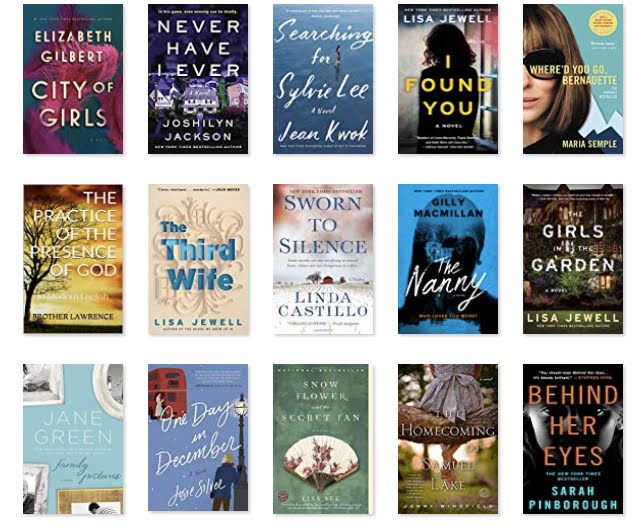
Snowflower and the Secret Fan was a re-read for book club. I loved it the first time AND the second time. Sworn to Silence was also a book club read, and that was chilling but satisfying! I loved The Homecoming of Samuel Lake, and all the pscyhological thrillers are fun. But my favorite out of all these is Where'd You Go, Bernadette? What a weird and wonderful novel, much like Eleanor Oliphant. I love quirky characters like Bernadette and Bee, Eleanor, and  The Rosie Project's Don Tillman.

I wanted to love City of Girls and Searching for Sylvia Lee, but meh.

Top Ten Books of the Year:

1. Eleanor Oliphant Is Completely Fine by Gail Honeyman
2 The 57 Bus: A True Story of Teenagers and a Crime That Changed Their Lives by Dashka Slater
3. Evicted: Poverty and Profit in the American City by Matthew Desmond
4. An American Marriage by Tayari Jones
5. Americanah by Chimamandah Ngozi Adichie
6. Born a Crime: Stories from a South African Childhood by Trevor Noah
7. The Great Alone by Kristin Hannah
8. The Tea Girl of Hummingbird Lane by Lisa See
9. The Tattooist of Auschwitz by Heather Morris
10. Walking to Listen: 4,000 Miles Across America, One Story at a Time by Andrew Forsthoefel

What about you?

(Visit me at SmallWorld Reads for occasional reviews throughout the year!)