

Math and writing are without a doubt the two subjects that worry
homeschooling parents the most. Which? How? When? Should I use this? Do this?
Am I doing enough? Too much? Wrong? Why won’t/can’t my kid multiplydivideaddsubtractwriteasentenceparagraphessaypaper??
As an English teacher, I am, naturally, regularly asked: what should I
use for writing? (Less regularly am I asked "what should I use for math?" In fact, probably never.) This is a surprisingly difficult question for me because there
are so many excellent resources out there. Free resources. An abundance of
excellent, free resources. It should be
easy to direct people various sites that do a great job teaching the basics:
how to write a sentence, how to craft a paragraph, how to succeed with a
5-paragraph essay, how to put a research paper together. What’s the problem?
Confidence— or lack thereof.
Over and over again, I hear parents say, “I am not a good
writer. I don’t know how to teach writing.” I hear parents comparing their kid
to another kid, even though we all know the mantra “Don’t compare yourselves to
others!” Even though we understand in our bones that our friend’s kid is just
one of those kids who loves to write, and our kid just doesn’t yet. We all do
it.
The bottom line is that we’re afraid of screwing our kids
up.
Ahh. Julie Bogart to the rescue. I’ve been advocating
Brave Writer for years just because I love Julie’s philosophy. I have always
thought that if I were to write a curriculum, it would look like
Brave Writer. Brave Writer
offers lots of online courses which look amazing and which I have heard
firsthand (from one of my students who wanted extra writing) are superb.
Awhile back I shamelessly begged for a review copy of The Writer’s Jungle because I realized that I really shouldn’t be telling all these homeschooling parents to buy it without having ever actually looked at it. Because, you know.
When they asked, “Do you like it?” I would have to honestly reply, “Actually,
I’ve never seen it. But I love her philosophy and I feel certain I would love it!”
OK. Now I have an actual copy of The Writer’s Jungle (thank you, Julie!), and I
can say without hesitation: every homeschooling parent should own this, read it
cover to cover, and then use it for the duration of their homeschooling years.
First of all, let me clarify that this isn’t a book filled
with lesson-by-lesson, “do-this,-now-do-that” plans on teaching your child to
write. The Writer’s Jungle takes a holistic approach to the writing process:
- providing understanding of how and why for the teacher,
- giving relief and assurance for the parent,
- building confidence for the teacher/parent and student, and
- delving into actual writing opportunities.
You will need to commit to reading, underlining, and making
some notes in the margin. These are good things! This isn’t the kind of
instruction manual that allows you to dig in after a three-page introduction.
Bogart has reasons why—and you should read them.
For example, I frequently have moms who say “My son hates to
write.” Bogart would be a great comfort to these moms:
“Unfortunately, not all writing problems turn out to be writing problems. Some of our kids are simply throwing hissy fits and need to be told so. By junior high, these fits are especially ugly. Their hormonal bodies give them power. We mothers are first hurt and then angry.
Ruth Beechik reminded me that a lot of writing that started out fresh and unspoiled in elementary school becomes anemic in junior high. Our kids have been in school for years now and are less enamored with the daily grind, I mean, routine. They are savvy enough to think of short-cuts to finishing their school work and balk at being made to put out extra exertion.
Writing requires effort and reflection. Some of our boys, especially, don’t want to engage in that kind of work. They look for quick fixes and entertainment.”
And this one:
"The other language arts arena that mothers obsess over is grammar instruction. Just for the record, grammar has very little to do with writing. It has everything to do with understanding the science of language and making sure that you use standard American English when you write. I recommend hitting it three times over the life span of a student: once in elementary school, once in junior high and once in high school."
If you know me, you know how often I recommend exactly that “hit it three times” approach— and how people look at me when I’m crazy when I say you don’t have to pound grammar into their heads every single year forever.
And I love this quote, which is exactly why I don’t like a lot of other writing programs. They produce kids who can write technically correct but extraordinarily uninspired papers:
“Likewise, the report about Vermont that your daughter wrote shouldn’t be a fulfillment of some list of state report topics. It should start there, perhaps, but it must sing in the end. It must have its own quirks, insights and that fresh interpretation that is unique to your child in addition to the evidence of research.”So where to start? As Bogart says, “Abandon this constant need to determine grade level. Start out by ignoring writing in its traditional sense. Instead, get interested in your child’s mind.” And this is what she encourages in The Writer’s Jungle: get to know your child, what makes your child tick, and what excites your child. Don’t feel bound by traditional writing methods.
Let me say again: this is not a book of lesson plans. This is a guide to giving a parent confidence, ideas, and many practical exercises for teaching writing. If you’re looking for a program that teaches rote writing, this isn’t it. This is oh-so-much better. I wish every homeschooling parent would read and then re-read it every year or so, using Bogart’s ideas and gaining confidence—and spreading that confidence to their kids.
Below are the Table of Contents pages.
 | |
| 2012 Writer's Jungle |
 |
| 2012 Writer's Jungle |
In each of the chapters, Bogart explains/philosophizes (I think of this as her “pep talk” portion) and then gives exercises, examples, ideas, evaluation examples, and more. Here’s an excerpt from Chapter 3 “The Sights Along the Way”:
The “experts” claim to have the knowledge of good and bad writing. Meet the serpents of our imaginations: authors of writing curricula, professional educators, even other well-meaning mothers. We fear that they all say essentially the same thing about us behind our backs. “You can’t teach writing. I’ve seen your child’s work and it’s a joke. I wouldn’t line the cat box with the stuff your kids put out.”… After you worry about how badly you’re missing the mark in teaching your kids to write, these same snakes beguile you with bewitching words: “Listen to me and I will show you the knowledge of good and bad writing.”
You lean closer. After all, writing is central to any good homeschool. And you aren’t secure in your ability to teach it. You listen more intently.…
…The advice of experts, daily repetition and sheer volume will fail you in the end. Once you admit it, you’ll be ready to exit Eden: the land of “Perfect Writing.” West of Eden lies a different landscape altogether, a wild jungle filled with insights, bursts of creativity, bad spelling, unrefined punctuation and surprising metaphors.
There are fewer completed assignments here. Initially the writing will look more like rocks than jewels, but the rocks that are carefully honed into gems become all the more precious as a result. The final papers are compelling to write and read because they come from a living source: the imaginative and powerful minds of children.
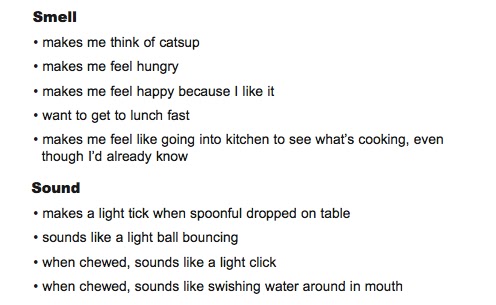
Later in this chapter, Bogart provides a fantastic series of exercises on using the 5 senses to observe and describe an object. Here is an example of the “smell” and “sound” exercises:

And then later in the chapter, she gives examples of student writing.
(This is from “Eli’s observation of meatloaf”) :
 |
| From The Writer's Jungle 2012 |
This isn’t about developing profound academic writers—although I bet a lot of students will head that way after learning the writing process from The Writer's Jungle. This is about giving kids the tools and practice to be competent communicators. This is about not hating to write—even loving to write! The Writer's Jungle is inspiring, freeing, and confidence-building for parents and students of all ages.
Want to see how The Writer's Jungle looks in practice? Check out Lora's post on Simple Homeschool about Becoming Brave Writers. Here's a preview: "Before, writing was a subject that caused strife and frustration in our home. Now, writing is our favorite part of the week. It strengthens our relationships, incites conversation, and gives us new ways to entertain and encourage each other."Other reviews:
- Cathy Duffy and One Magnificent Obsession review The Writer's Jungle
- And how about Farrar Williams' post is called Hallelujah, I found a Language Arts Program I Actually Like!
If you're intrigued and want to think about getting started with The Writer's Jungle, check out the Getting Started with Brave Writer page. If I were doing this whole homeschooling journey again, I would absolutely use The Writer's Jungle. It would have dog-eared, salsa-stained, highlighted pages with post-it notes sticking out all over the place.
My final recoomendation: Toss out those boring workbooks and tedious textbooks. It is worth the extra time and effort.
Be brave!
Before, writing
was a subject that caused strife and frustration in our home. Now,
writing is our favorite part of the week. It strengthens our
relationships, incites conversation, and gives us new ways to entertain
and encourage each other. - See more at:
http://simplehomeschool.net/writers-jungle/#sthash.69ASZO9P.dpuf





 Posted by
  Posted by
